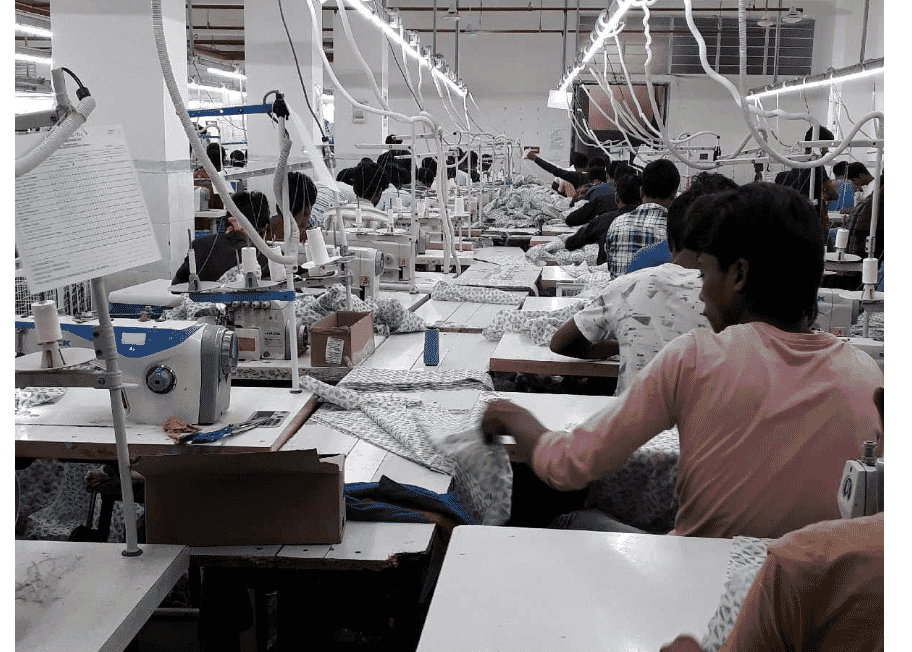
A freight forwarder in India is the company that turns "the goods are ready" into "the goods are on a vessel". They do not own ships or planes. They buy space in bulk, consolidate cargo, file the Indian export paperwork and hand the shipment to a carrier, and the good ones earn their fee several times over on a first shipment.
The decision that costs brands money is not which forwarder to appoint. It is whether to appoint one at all, or to accept the one your supplier nominates. Those are very different positions, and the second one usually costs more, through destination charges you never see quoted.
This guide covers what a forwarder actually does, how they differ from a customs broker and a carrier, what they charge, how to read a quote line by line, which registrations they should hold, and where these relationships go wrong.
Note: India Clothing Factory is a group of documented clothing factories in India, producing for brands from 100 units. Ranges in this guide are given as market ranges, not as quotes from a specific factory. Ranges come from published industry sources. We confirm exact MOQ and price with the factory when you send a brief.
Key takeaways
- A forwarder arranges transport and documentation. A carrier moves the goods. A customs broker files the entry. They are three jobs.
- On a sea shipment, the ocean rate is frequently under half the all-in cost. The rest is origin, destination and handling charges.
- A supplier-nominated forwarder is not free. Their margin appears in destination charges you are billed for after arrival.
- Appoint your own forwarder at FOB and you control everything downstream of the Indian port.
- Ask for an itemised all-in door-to-door quote. A single figure is an opening position, not a quote.
- In India, check the IEC code and customs broker licence; in the US, check the broker holds a CBP licence.
- The cheapest quote is usually the one with the most charges omitted from it.
What Does a Freight Forwarder in India Do?
They arrange the movement and the paperwork rather than performing the carriage. In practice that means booking space with a shipping line or airline, collecting cargo from your factory, consolidating it if it does not fill a container, filing the Indian export declaration, and issuing the transport document your bank or buyer needs.
For a first-time exporter or importer, most of the value is in the third and fourth of those. Indian export clearance requires filings a foreign company cannot make itself, and the documentation chain from shipping bill to bill of lading to certificate of origin has to be internally consistent or the goods stop (International Trade Administration).
What a forwarder does not do is take commercial responsibility for your goods. They are not the seller and not the insurer, and their liability under a standard bill of lading is limited in ways that surprise people who have never read one.
Citation Capsule: A freight forwarder in India arranges cargo movement rather than performing carriage: booking carrier space, collecting and consolidating cargo, filing Indian export declarations, and issuing transport documents. Indian export clearance requires filings a foreign company cannot make directly, which is why overseas buyers appoint either a forwarder with an Indian presence or an Indian agent.

Related reading: Shipping from India to the USA · Wholesale Clothing India · Courier From India to the USA
Forwarder, Customs Broker, Carrier: Who Does What?
Three separate jobs, frequently sold together, and the bundling is where accountability goes missing. When a shipment is held, knowing which of the three is responsible determines who you telephone and what you can reasonably ask them to fix. Ask which of the three roles your provider is performing on each line of the invoice.
| Role | What they do | Who they answer to | Where they sit |
|---|---|---|---|
| Freight forwarder | Books space, consolidates, arranges pickup and documentation | Whoever appointed them, which is the point | Both ends, often through an agent network |
| Carrier shipping line or airline | Physically moves the cargo, issues the master transport document | The party named on the master bill | Port to port or airport to airport |
| Customs broker, India | Files the shipping bill and export clearance | The Indian exporter | Origin only |
| Customs broker, USA | Files the import entry, classification and duty | You, as importer of record | Destination only |
| Consolidator or NVOCC | Buys container space wholesale and resells it by the cubic metre | Their own book, not yours | Between the forwarder and the carrier |
Sources: US Customs and Border Protection customs broker requirements; International Trade Administration documentation guidance for India. The third column is the one that decides whose interests are being served.
The third column is the whole argument for appointing your own forwarder. A forwarder appointed by your supplier answers to your supplier. That is not a criticism of them, it is simply who is paying them, and it becomes visible the first time you want a shipment held pending an inspection result.
Citation Capsule: Freight movement from India involves distinct roles: the forwarder arranges transport and documentation, the carrier physically moves cargo and issues the master transport document, an Indian customs broker files export clearance. A US customs broker licensed by Customs and Border Protection files the import entry. Each answers to the party that appointed them.
Do You Need a Forwarder in India or in the USA?
You need coverage at both ends and you should appoint one party responsible for it. Most brands do this by appointing a forwarder with an Indian agent network rather than appointing two separate companies, because the handover between two unrelated forwarders is where shipments stall.
If your Incoterm is FOB, the seller handles Indian export clearance and your forwarder takes over at the vessel rail (International Chamber of Commerce). You still want your forwarder involved at origin for booking and cargo collection, which is normal and which the seller should accommodate.
If your Incoterm is EXW, you own everything from the factory door including Indian export filings, and you unambiguously need an origin forwarder. This is the situation where brands discover that a foreign company cannot file an Indian shipping bill.
What Is a Nominated Forwarder and Should You Use One?
A nominated forwarder is one your supplier appoints and you inherit. It is convenient, it removes a decision, and it is the most common way an importer ends up paying charges they cannot question. The charges arrive at destination, where you have no leverage and no competing quote to test them against.
The mechanics are straightforward. The supplier gets a competitive origin rate, sometimes free of charge, and the forwarder recovers the difference in destination charges billed to you after the goods have arrived and cannot easily be moved. Terminal handling, documentation fees, deconsolidation and delivery order fees are all legitimate lines that can be priced well above market.
The fix is to take control at FOB and instruct your own forwarder. You then see the whole cost before the goods move, which is the only point at which you have any leverage.
Skip the search: the India factory directory ($49) lists documented factories by category, city and capability, with the verification status of each. One-time payment, instant download.
How Do You Choose a Freight Forwarder in India?
On lane experience and quote transparency, not on size. A large global forwarder with no volume on your specific lane will quote you a buy rate they do not really have. A small Chennai forwarder shipping knitwear to the US east coast every week will have a better rate and a better answer when something goes wrong.
Ask three questions and the field narrows quickly. How many shipments do you move on this lane each month. Who is your agent at the destination port. What does your all-in door-to-door quote include and exclude.
The third one is the test. A forwarder who answers it with a complete charge list, including the destination lines they do not control, is telling you they expect to be measured on the total. One who answers with an ocean rate and a promise that destination charges are reasonable is not.
What to ask before appointing a forwarder in India
- Monthly volume on your specific lane, not global turnover
- Named destination agent, and whether you may contact them directly
- An itemised all-in quote covering origin, freight, destination and inland
- Their IEC code and Indian customs broker licence number, or their licensed partner's
- Written free-time at destination, because demurrage and detention are where surprise costs live
Every one of these is answerable in a single email by a forwarder who wants the account. Vagueness on any of them is the answer to the question you were really asking.
What Does a Freight Forwarder Charge?
A margin on the freight they buy, plus fixed fees per shipment and per document. The margin is invisible by design. The fixed fees are visible and are where quotes differ most, because they do not scale with shipment size and therefore hurt small shipments disproportionately.
| Charge | Indicative level | Notes |
|---|---|---|
| Freight margin | Built into the rate | Not disclosed. Benchmark by tendering the lane, not by asking |
| Documentation fee | $40 to $90 per shipment | Charged at both ends by different entities |
| Bill of lading fee | $45 to $100 | Higher for an original set than for a telex release |
| Customs entry, US | $120 to $250 per entry | Per entry, not per carton. Consolidation saves this |
| Deconsolidation, LCL | $60 to $180 | Destination charge, and the classic nominated-forwarder line |
| Delivery order fee | $50 to $120 | Charged to release cargo. Frequently omitted from quotes |
Market ranges compiled from published freight marketplace and forwarder tariff data, expressed in USD. They are not quotations and vary considerably by lane, port and account.
Notice how many of those are per shipment. Two shipments of 300 pieces cost meaningfully more to move than one shipment of 600, and the difference has nothing to do with freight. Consolidating is the single most reliable saving available to a small importer.
Citation Capsule: Freight forwarder charges combine an undisclosed margin on purchased freight with fixed per-shipment fees including documentation, bill of lading issuance, customs entry, deconsolidation and delivery order release. Because these fees are levied per shipment rather than per unit, consolidating two small shipments into one entry produces a larger saving for small importers than negotiating the freight rate.
Try it free: pressure-test your landed cost with the India production cost calculator. 60 seconds, no email required.
Citation Capsule: A supplier-nominated freight forwarder is appointed and paid by the seller, and typically recovers a discounted origin rate through destination charges billed to the buyer after arrival. Taking control of the shipment at FOB and appointing an own forwarder places the complete door-to-door cost in front of the buyer before the cargo moves. That is the only point at which the buyer has leverage.
How Do You Read a Forwarder Quote?
By looking for what is missing. A forwarder quote is a list of charges the forwarder intends to bill, and the cheap quotes are almost always cheap because lines have been left off rather than priced low. Check the Incoterm at the top, that a destination section exists at all, the free time, and the validity and the currency.
Check the Incoterm at the top. An FOB quote and a DDP quote are not comparable numbers and putting them side by side is the most common error in freight tendering.
Check the destination section exists. If the quote runs from origin to port of discharge and stops, everything after discharge is unquoted, and in the example above that is more than half of the cost.
Check the free time. Free days at the destination terminal before demurrage begins, and free days on the container before detention begins. Two free days on a shipment you cannot clear in two days is a cost, not a term.
Check the validity and the currency. Ocean rates move monthly. A quote without a validity date is a conversation, not a price.
Which Registrations Should an Indian Forwarder Hold?
At minimum an Importer Exporter Code and, for anyone filing customs documents, a customs broker licence. Neither is a quality mark and both are checkable, which is more than can be said for most claims made in a sales email.
The Importer Exporter Code is issued by the Directorate General of Foreign Trade and is the base registration for any export activity (DGFT). Customs filing is a separate licensed activity, and forwarders who do not hold the licence work through a partner who does (DGFT).
At the US end, the person filing your import entry must hold a customs broker licence issued by Customs and Border Protection (US Customs and Border Protection). Ask for the licence details. An importer of record remains liable for what is filed on their behalf, which makes this a question about your own exposure rather than about their credentials.
No tech pack yet? Factories quote from specifications, not from photographs. A factory-ready single-style tech pack is $79: measurements, construction, fabric, trims and labelling in the format an Indian factory costs from.
What the Forwarder Handles and What Stays Yours
The division is clearer than most people assume, and the items that stay yours are the ones that carry legal liability. A forwarder can prepare a document. They cannot take responsibility for the truth of what it says about your goods.
| Task | Forwarder | You |
|---|---|---|
| Booking carrier space and scheduling | Yes | Confirm the cargo ready date is real |
| Cargo collection and consolidation | Yes | Specify carton dimensions and packing |
| Export declaration in India | Through a licensed broker | Nothing, if the Incoterm is FOB or above |
| Tariff classification | Advises | Owns it. The importer of record is liable |
| Valuation declared to customs | Transcribes | Owns it. It must match your payment |
| Cargo insurance | Can arrange | Decide the cover. Carrier liability is not insurance |
| Duty payment | Advances it | Owes it, plus the disbursement fee |
Sources: US Customs and Border Protection importer and broker guidance; ICC Incoterms 2020. The rows marked as owned by the importer remain the importer's liability regardless of who prepared the paperwork.
Two rows deserve emphasis. Classification and valuation stay with you as importer of record no matter who typed them, and an error repeated across a year of shipments becomes a retroactive liability rather than a one-off correction (USITC).
Citation Capsule: Tariff classification and declared customs valuation remain the legal responsibility of the importer of record even when a freight forwarder or customs broker prepares the filing. Carrier liability under a standard bill of lading is limited and does not substitute for cargo insurance, which the importer must decide on separately.

Five lines to check on every forwarder quote
- The Incoterm at the top, because FOB and DDP quotes are not comparable numbers
- A destination section that exists, covering everything after the port of discharge
- Free time in days at the terminal and on the container, stated separately
- A validity date, since ocean rates move monthly
- Who files the certificate of origin and what it costs
Cheap quotes in this trade are almost never cheap rates. They are complete quotes with lines removed, and the removed lines arrive later.
Where Forwarder Relationships Go Wrong
Four patterns, and three of them are visible before the first shipment if you know to look. They are the quote that was not all-in, the nominated forwarder you never chose, demurrage nobody warned you about, and a booking made against a date that was never real.
The quote that was not all-in. Destination charges arrive after the goods do, when you have no alternative but to pay them. Prevented entirely by insisting on an itemised door-to-door quote.
The nominated forwarder you never chose. Their margin is recovered from you at the destination, and you have no commercial relationship to argue from. Prevented by taking control at FOB.
Demurrage nobody warned about. Free time runs out while you sort a customs query, and the daily charge is larger than most people expect. Prevented by agreeing free time in writing and having your broker engaged before arrival.
The booking against a date that was never real. This one starts on the factory floor. A vessel missed by two days usually means waiting for the next sailing, and forwarders cannot fix production. Our guide to the garment manufacturing process covers where that slippage starts.
Appointing a Freight Forwarder
Appoint your own, on the lane where they actually have volume, and take control at FOB. That single decision removes the nominated-forwarder margin, gives you a destination agent you can call, and puts the complete cost in front of you before anything moves.
Tender on the all-in door-to-door figure with the lines itemised. Ocean rates are close to commoditised and the variance between forwarders lives almost entirely in the charges either side of the sea leg.
And consolidate wherever the calendar allows. Much of what a forwarder bills is per shipment rather than per unit, which means fewer, larger shipments beat any rate negotiation you are likely to win.
Frequently Asked Questions
What does a freight forwarder in India actually do?
They arrange transport rather than performing it: booking space with shipping lines or airlines, collecting and consolidating cargo, filing Indian export declarations through a licensed customs broker, and issuing the transport document. They do not own vessels and their liability under a standard bill of lading is limited.
Should I use the freight forwarder my Indian supplier nominates?
Usually not. A nominated forwarder is appointed and paid by your supplier, and typically recovers a discounted origin rate through destination charges billed to you after arrival, when you have no leverage. Taking control at FOB and appointing your own forwarder puts the whole cost in front of you before the goods move.
How much does a freight forwarder charge?
An undisclosed margin on the freight they buy plus fixed fees: documentation $40 to $90, bill of lading $45 to $100, US customs entry $120 to $250, deconsolidation $60 to $180 and delivery order release $50 to $120. Because these are per shipment, consolidating shipments saves more than rate negotiation.
What is the difference between a freight forwarder and a customs broker?
A forwarder arranges the movement and documentation. A customs broker files the customs entry and must be licensed, by the Indian authorities at origin and by US Customs and Border Protection at destination. Many forwarders offer both, either in house or through a licensed partner, but they are separate regulated activities.
Who is responsible if my tariff classification is wrong?
You are. Classification and declared valuation remain the legal responsibility of the importer of record regardless of who prepared the filing. This is why a classification review with your broker before the first shipment matters: an error repeated across a year of shipments becomes a retroactive liability.
Tell us the product and the quantity from 100 units. We place your production with the factory in our group built for it, normally within 24 hours, and you appoint your own forwarder and ship at FOB. No commissions. No markups. The factory bills you directly.
Get in contact Download the directory ($49)Need a tech pack? Get a factory-ready single-style tech pack for $79. See what's included.
Editorial note: all company names, certification marks and trademarks referenced here are the property of their respective owners. MOQ, cost and lead-time figures are market ranges compiled from the published sources listed below, not quotes from any individual factory, and they vary by product, fabric and season. Tariff figures were correct at the date of publication and the 2026 position is still moving. Always verify your own HTS classification and confirm terms directly with the factory before committing.
Sources
- USITC Harmonized Tariff Schedule: the current classification schedule and duty rates.
- US Customs and Border Protection: Customs broker licensing requirements and importer of record responsibilities.
- International Chamber of Commerce: Incoterms 2020 rules defining where cost and risk pass between seller and buyer.
- Directorate General of Foreign Trade: Guidance on customs and export filing procedures for Indian exporters.
- Directorate General of Foreign Trade: Importer Exporter Code registration, the base requirement for Indian export activity.
- International Trade Administration: India import requirements and documentation for goods moving in and out of India.
Further Reading
Background references for this topic. These are not cited above.
- Sheng Lu, FASH455, University of Delaware (2025): WTO-based analysis of global textile and apparel trade.
- US Customs and Border Protection: tips for new importers, including importer-of-record responsibility.
- US Customs and Border Protection: Basic importing and exporting guidance including entry procedures.
- Freightos: Freight rate structures, surcharges and the composition of origin and destination charges.