The garment manufacturing process runs in eight stages and only three of them involve a sewing machine. Brands who understand the sequence make better decisions about where to spend money and where to apply pressure. Brands who do not spend both in the wrong place, usually by negotiating the sewing charge while the fabric decision quietly sets their unit price.
The sequence is the same in Tiruppur as it is in Dhaka or Ho Chi Minh City. What differs by country is which stages are in the same building, and in India the answer changes completely between knit and woven production.
This guide to the garment manufacturing process walks each stage in order, explains what can go wrong in it, sets out how long each takes, and identifies the points where a brand actually has control rather than merely an opinion.
Note: India Clothing Factory is a group of documented clothing factories in India, producing for brands from 100 units. Ranges in this guide are given as market ranges, not as quotes from a specific factory. Ranges come from published industry sources. We confirm exact MOQ and price with the factory when you send a brief.
Key takeaways
- Eight stages: specification, sampling, fabric, cutting, sewing, finishing, inspection, packing.
- Fabric is the critical path on almost every order. It is 45 to 55 percent of cost and 3 to 6 weeks of time.
- Sewing is the visible stage and rarely the one that fails. Most defects originate in cutting and finishing.
- The sealed sample is the contract. Without one, quality is a matter of opinion at the point it matters most.
- Inspection at 80 percent packed is the industry standard, because it leaves time to rework.
- A brand controls the process at four points only: the tech pack, sample approval, fabric approval and the inspection standard.
- First order 12 to 16 weeks, repeat order 8 to 10. Sampling is what makes the first one longer.
What Are the Stages of the Garment Manufacturing Process?
Eight, running from a written specification to a packed carton. Each hands off to the next, and a failure early is cheap to fix and expensive to discover late. The single most common costly error in the whole chain is discovering a fabric problem after cutting.
| Stage | What happens | Typical duration | Who controls it |
|---|---|---|---|
| 1. Specification | Tech pack: measurements, construction, fabric, trims, labelling | Before anything else | You, entirely |
| 2. Sampling | Proto, fit and pre-production samples, ending in a sealed sample | 3 to 5 weeks | Shared, and it should be |
| 3. Fabric | Knitting or weaving, dyeing, finishing, inspection on arrival | 3 to 6 weeks | The mill, which is the problem |
| 4. Cutting | Marker making, spreading, cutting, bundling, numbering | 2 to 4 days | The factory |
| 5. Sewing | Line assembly in operations, with inline checks | 1 to 3 weeks | The factory |
| 6. Finishing | Washing, pressing, thread trimming, labelling, tagging | 3 to 7 days | The factory, often subcontracted |
| 7. Inspection | Final random inspection against an agreed standard | 1 day | You, if you book it |
| 8. Packing | Folding, polybagging, carton packing, marking | 2 to 4 days | The factory, to your specification |
Durations are market ranges compiled from published industry sources for export apparel production. They vary with construction, order size and whether fabric is stock or commissioned.
Read the fourth column before the third. Two of the eight stages are entirely yours, one is genuinely shared, and five belong to the factory. Brands who try to manage the five they do not control while neglecting the two they do get the worst of both.
Citation Capsule: Garment manufacturing runs in eight stages: specification, sampling, fabric production, cutting, sewing, finishing, inspection and packing. Fabric is the longest stage at three to six weeks and is usually the critical path. Sewing, the most visible stage, typically takes one to three weeks and is rarely the source of quality failures.
Related reading: Clothing manufacturers in India · Clothing suppliers in India · Wholesale Clothing India · Freight forwarders in India
Where Does the Process Actually Start?
With a written specification, not with a conversation. Factories cost from documents, and the quality of the document sets the quality of the quote. A photograph plus a size chart produces a guess with margin for error priced into it; a tech pack produces a number the factory can defend.
A workable specification carries measurements at every point of measure with tolerances, construction details including stitch types and seam allowances, a fabric specification with weight and composition, a trims list, and labelling and packing instructions (ASTM). None of that is exotic and all of it is routinely absent from first enquiries.
The commercial effect is larger than the technical one. Two factories quoting from the same tech pack are quoting the same garment, so their prices are comparable. Two factories quoting from a photograph are quoting two different garments, and the cheaper one is usually cheaper because it assumed less.
Citation Capsule: Garment production begins with a written technical specification rather than a sample or photograph. A complete tech pack contains points of measure with tolerances, construction and stitch details, fabric weight and composition, a trims list, and labelling and packing instructions. Quotes produced from a common tech pack are directly comparable; quotes produced from photographs are not.
No tech pack yet? Factories quote from specifications, not from photographs. A factory-ready single-style tech pack is $79: measurements, construction, fabric, trims and labelling in the format an Indian factory costs from.
What Happens During Sampling?
Three or four samples in sequence, each answering a different question, ending in a sealed sample that becomes the reference for bulk. Compressing this stage is the most common way brands save three weeks and lose a season. The sequence runs proto, fit, pre-production and sealed.
The proto sample answers whether the factory understood the design. It is often made in whatever fabric is to hand, and judging it on hand-feel is a mistake.
The fit sample answers whether the measurements work on a body. This is where you iterate, and two or three rounds is normal rather than a warning sign.
The pre-production sample is made in the actual bulk fabric, with the actual trims, on the actual production line. It is the only sample that predicts bulk, and skipping it is the single highest-risk shortcut in the process.
The sealed sample is the approved pre-production sample, signed and retained at the factory. When a bulk garment is disputed, this is what it is compared against, and a programme without one has no agreed standard to argue from.
The four samples and what each one proves
- Proto: the factory understood the design. Judge shape, not fabric
- Fit: the measurements work. Expect two or three rounds
- Pre-production: bulk fabric, bulk trims, bulk line. The only predictive sample
- Sealed: signed and retained at the factory as the reference standard
- Size set: one garment per size, proving the grading rather than the base size
The pre-production sample is the one brands skip under time pressure, and it is the one that would have caught the problem they later discover in a carton.
Why Is Fabric the Critical Path?
Because it takes longer than everything downstream of it and because nothing can start until it arrives. Fabric is 45 to 55 percent of the cost of a garment and typically three to six weeks of the schedule, and in India the mill sits outside the garment factory in most categories.
This is why minimums behave the way they do. A sewing line can run 100 pieces without difficulty. A mill will not weave 100 metres of a commissioned construction. Any product needing bespoke fabric therefore inherits the mill's minimum rather than the factory's.
Two practical consequences follow. Ask your factory for the fabric delivery date rather than the shipment date, because the fabric date is what actually predicts whether you ship on time. And where a minimum is quoted higher than you expected, ask whether the constraint is fabric before you negotiate: switching to a stock fabric usually moves the number further than haggling does.
Citation Capsule: Fabric is the critical path in garment manufacturing, representing 45 to 55 percent of unit cost and three to six weeks of the production schedule. Because Indian mills generally sit outside the garment factory, products requiring commissioned fabric inherit the mill's weaving minimum rather than the sewing line's.
How Does Cutting Work?
A marker is made, fabric is spread in layers, the stack is cut, and the pieces are bundled and numbered by layer so that panels from the same section of the spread stay together. That last step is the one nobody thinks about and it prevents the most annoying defect in apparel: shade variation within a single garment.
Marker efficiency is where fabric consumption is decided, and consumption is where cost is decided. A marker at 82 percent efficiency and one at 88 percent produce the same garment from measurably different amounts of cloth, and on a fabric that is half your unit cost that difference is real money.
This is also where fabric width matters. A cheaper fabric at a narrower width can cost more per garment than a dearer one at a wider width, because the marker changes. Always compare fabrics on cost per garment rather than on cost per metre.
What Happens on the Sewing Line?
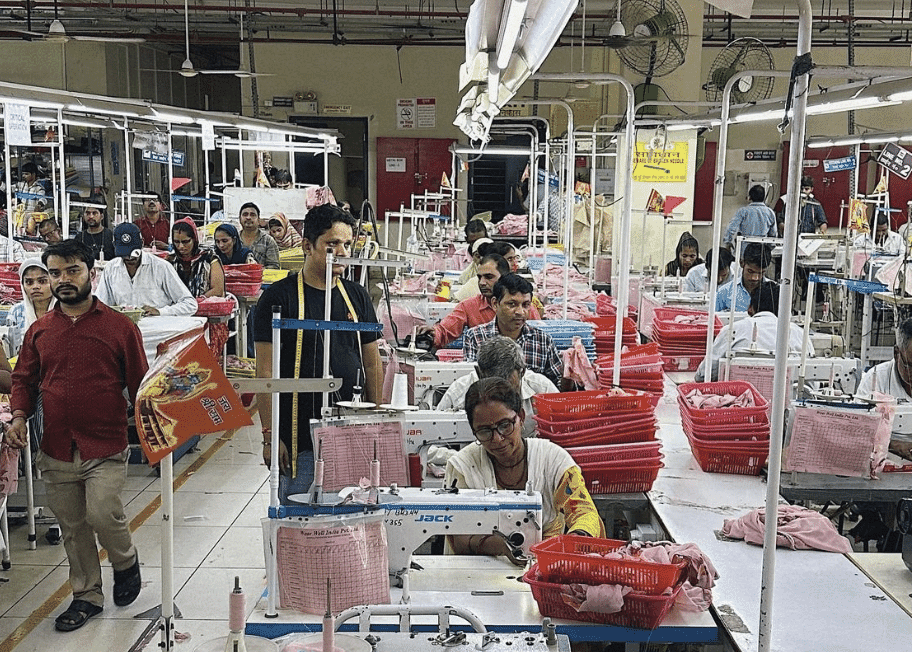
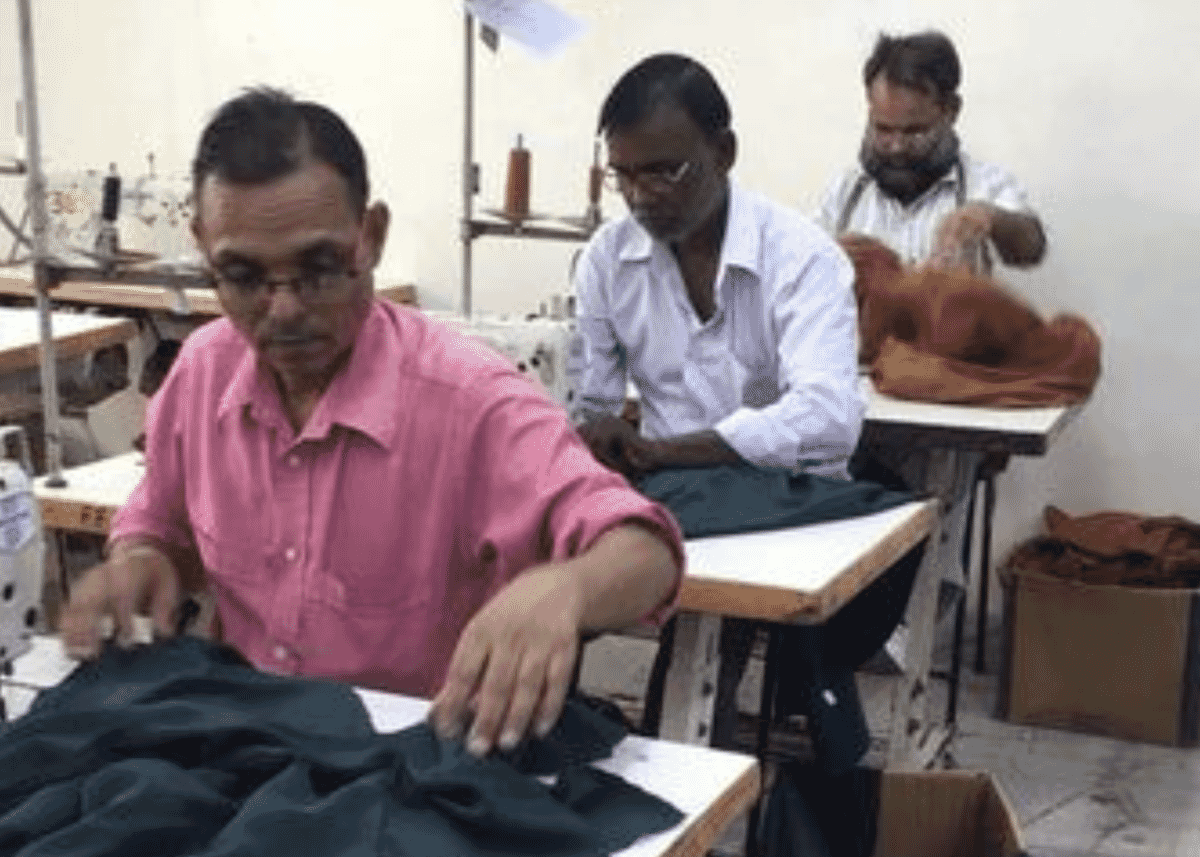
The garment is broken into operations and distributed across a line, with each operator performing one or two of them. A T-shirt might be fifteen operations; a tailored jacket several times that. Line balancing, which is the allocation of operators to operations so nothing starves and nothing queues, is what determines output.
Inline checking happens at the line rather than at the end, and this is the difference between a well-run floor and a poorly run one. Catching a seam problem at operation six costs a re-sew. Catching it at final inspection costs a rework of the entire batch.
What a brand controls here is narrow and worth using. The stitch types, seam allowances and stitches per inch in your tech pack are the specification the line is set to. Leaving them unspecified means the factory chooses, and the factory chooses what is fastest. A knit tee and a structured woven shirt are set up very differently on the same floor. Our guide to T-shirt manufacturers in India sets out the fabric and neck specification a tee needs.
What Is Finishing and Why Does It Fail?
Everything between the last stitch and the polybag: washing, pressing, thread trimming, spot cleaning, labelling and tagging. It is frequently subcontracted, it is where garments are handled most, and it is responsible for a disproportionate share of the defects found at final inspection.
Washing is the highest-risk operation in the stage. A garment that passed every measurement before washing can fail after it, because shrinkage was not tested on the bulk fabric. This is why the pre-production sample must be made in bulk fabric and washed the way bulk will be washed.
Pressing failures are the second, and they are mostly invisible until the customer opens the parcel. Poly-content fabrics glaze under too much heat. A well-run finishing floor tests its settings on the bulk fabric before running the order.
Citation Capsule: Finishing covers washing, pressing, thread trimming, spot cleaning, labelling and tagging, and is frequently subcontracted by the garment factory. It accounts for a disproportionate share of defects found at final inspection. Washing is the highest-risk operation, because shrinkage not verified on bulk fabric can move a garment outside its measurement tolerance after it has passed every earlier check.
| Where the defect was made | Share of defects found at final inspection | Typical cause |
|---|---|---|
| Finishing | Highest | Pressing marks, thread ends, spotting, wash shrinkage |
| Cutting | High | Shade variation across panels, notching, marker error |
| Fabric | Moderate | Weaving and knitting faults, dyeing barre, fabric holes |
| Sewing | Moderate | Skipped stitches, seam puckering, uneven topstitching |
| Trims and labelling | Low but disproportionately costly | Wrong care label, missing size label, incorrect origin marking |
Typical defect origins at final inspection; the ranking varies by product and factory. The last row is small in volume and large in consequence, because incorrect origin or care labelling is a customs and compliance problem rather than a quality one.
Citation Capsule: Quality is checked at four points in garment manufacturing. These are inline at the sewing line, at end of line, in an internal final audit, and in a final random inspection commissioned by the buyer. The buyer-commissioned inspection is conventionally performed at 80 percent packed, late enough to reflect genuine bulk quality and early enough to allow rework before the shipping date.
Where Is Quality Actually Checked?
Four times, and only one of them is visible to you. Inline checking at the sewing line, end-of-line checking, an internal final audit, and the final random inspection you book yourself. A factory doing only the last of those is not running quality control, it is running sorting.
The final random inspection is conventionally performed at 80 percent packed, which is late enough that the order reflects real bulk quality and early enough that there is time to rework and still ship (SGS). Booking it at 100 percent packed removes your remedy.
The inspection standard needs agreeing before production rather than at the point of dispute. What counts as a major defect, what counts as minor, and what acceptance level applies are all negotiable and all meaningless if agreed afterwards.
Agree these before the line starts, not after
- The sealed sample, signed by both sides and retained at the production unit
- Measurement tolerances at each point of measure, in the tech pack
- The inspection standard and acceptance level, agreed in writing
- Who books the inspection, and it should be you
- The remedy for a fail: rework, discount or rejection, decided in advance
Every line here is cheap to agree before production and impossible to agree once a container is packed and a delivery date is three days away.
Packing, Cartons and the Shipping Handover
The last stage is where production hands over to logistics, and the specification you write here shows up in your freight bill. Carton dimensions determine volumetric weight, and on air and courier shipments volumetric weight usually exceeds actual weight for apparel.
Two packing decisions matter commercially. Solid cartons, meaning one style and size per carton, are simpler to inspect and to receive. Assorted cartons, packed in a size ratio, are faster to distribute but harder to verify. Choose deliberately rather than inheriting the factory's habit.
Specify carton dimensions, maximum gross weight, the shipping marks and the polybag specification in the purchase order. All four of those are decisions somebody will make, and the only question is whether it is you.
How Long Does Each Stage of the Garment Manufacturing Process Take?
Twelve to sixteen weeks for a first order and eight to ten for a repeat, with the difference sitting almost entirely in sampling. Repeat orders against an existing sealed sample skip three to five weeks and are the reason second seasons feel so much easier than first ones.
Two Indian calendar effects sit on top of that. Diwali closes most factories for one to two weeks in October or November and the date moves each year, so a schedule built on last year's calendar will be wrong. The monsoon between June and September does not stop production but it slows dyeing, drying and finishing, particularly in coastal clusters.
Our guide to Indian clothing suppliers covers who to ask for that date. Build the schedule backwards from the fabric delivery date. Everything after fabric is reasonably predictable. Everything before it is where schedules are actually lost.
What a Brand Controls at Each Stage
Four points, and they are all upstream. This is the useful conclusion of understanding the process, because it tells you where effort returns something. They are the tech pack, sample approval, fabric approval and the inspection standard. After the fabric is cut, a brand's influence is largely limited to accepting or rejecting what was made.
The tech pack. Complete control, and it propagates through every later stage. Effort here is worth more than effort anywhere else in the chain.
Sample approval. Complete control, and the only honest moment to say no. Approving a pre-production sample you are unsure about is approving the bulk.
Fabric approval. Real control if you ask for it. Requesting a fabric test report and a bulk swatch before cutting is normal practice and stops the most expensive class of failure.
The inspection standard. Complete control if agreed in advance, none at all if raised afterwards.
Everything else is the factory's to run. Understanding the process is not about supervising a sewing line from another continent. It is about knowing which four decisions are yours and taking them properly.
Frequently Asked Questions
What are the stages of garment manufacturing?
Eight: written specification, sampling, fabric production, cutting, sewing, finishing, inspection and packing. Fabric takes three to six weeks and is usually the critical path. Sewing, the most visible stage, takes one to three weeks and rarely causes the quality problems brands attribute to it.
How long does garment production take?
Twelve to sixteen weeks for a first order and eight to ten weeks for a repeat against an existing sealed sample. The difference is sampling, which takes three to five weeks. Diwali closes Indian factories for one to two weeks on a date that moves each year, and the monsoon slows dyeing and finishing.
What is a sealed sample and why does it matter?
It is the approved pre-production sample, signed by both parties and retained at the factory as the reference for bulk production. When a bulk garment is disputed, it is compared against the sealed sample. A programme without one has no agreed quality standard at the moment a standard is needed.
When should a pre-shipment inspection happen?
At around 80 percent packed. That is late enough for the inspection to reflect genuine bulk quality and early enough to leave time for rework before the shipping date. Booking at 100 percent packed removes your remedy, because there is no time left to fix anything the inspection finds.
Why is fabric more important than the sewing price?
Because fabric is 45 to 55 percent of unit cost against 20 to 30 percent for cut, make and trim, and because it takes three to six weeks against one to three for sewing. It also sets your minimum: commissioned fabric inherits the mill's weaving minimum rather than the sewing line's.
Tell us the product and the quantity from 100 units. We place your production with the factory in our group built for it, normally within 24 hours, and you work with the factory directly from sampling onwards. No commissions. No markups. The factory bills you directly.
Get in contact Download the directory ($49)Need a tech pack? Get a factory-ready single-style tech pack for $79. See what's included.
Editorial note: all company names, certification marks and trademarks referenced here are the property of their respective owners. MOQ, cost and lead-time figures are market ranges compiled from the published sources listed below, not quotes from any individual factory, and they vary by product, fabric and season. Always confirm terms directly with the factory before committing.
Sources
- SGS: Final random inspection service definition, covering batch sampling and acceptance criteria before shipment.
- ASTM International: Standards and publications covering textile and apparel test methods.
Further Reading
Background references for this topic. These are not cited above.
- amfori BSCI: social audit system documentation.
- Freightos: Freight resources covering ocean and air rate structures and surcharges.
- Directorate General of Foreign Trade: Guidance on Indian export clearance procedure.
- US Customs and Border Protection: Basic importing and exporting guidance.
- US Customs and Border Protection: Textiles and apparel priority trade issue, covering labelling, fibre content and origin requirements.
- Worldwide Responsible Accredited Production: Facility certification programme for apparel manufacturing.
- India Brand Equity Foundation: Textile industry structure, mill capacity and the relationship between fabric and garment production.
- Ministry of Textiles, Government of India: Annual reports covering the structure of Indian textile and apparel production.
- International Trade Administration: India documentation requirements relevant to packing lists and shipping marks.