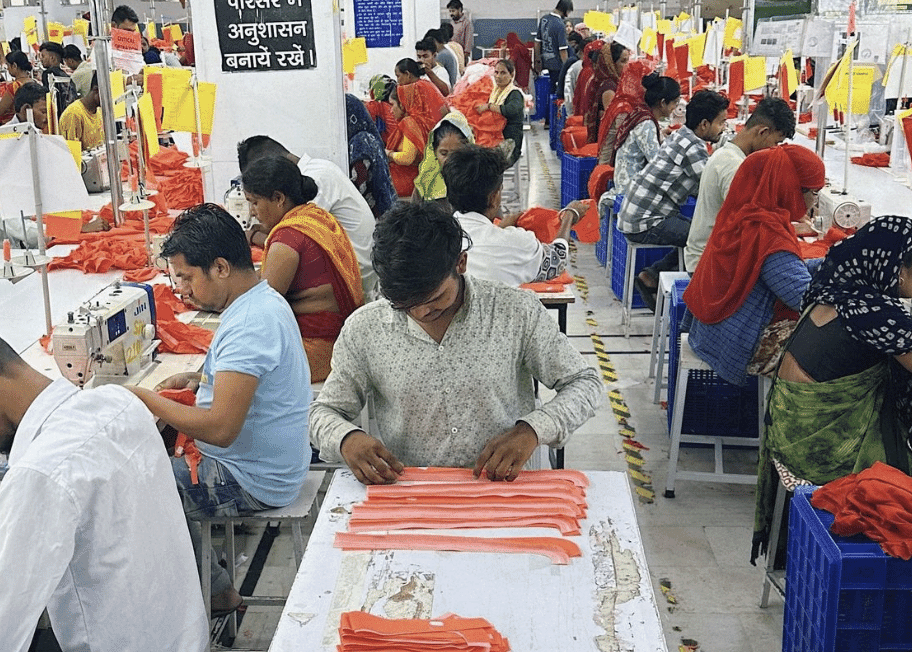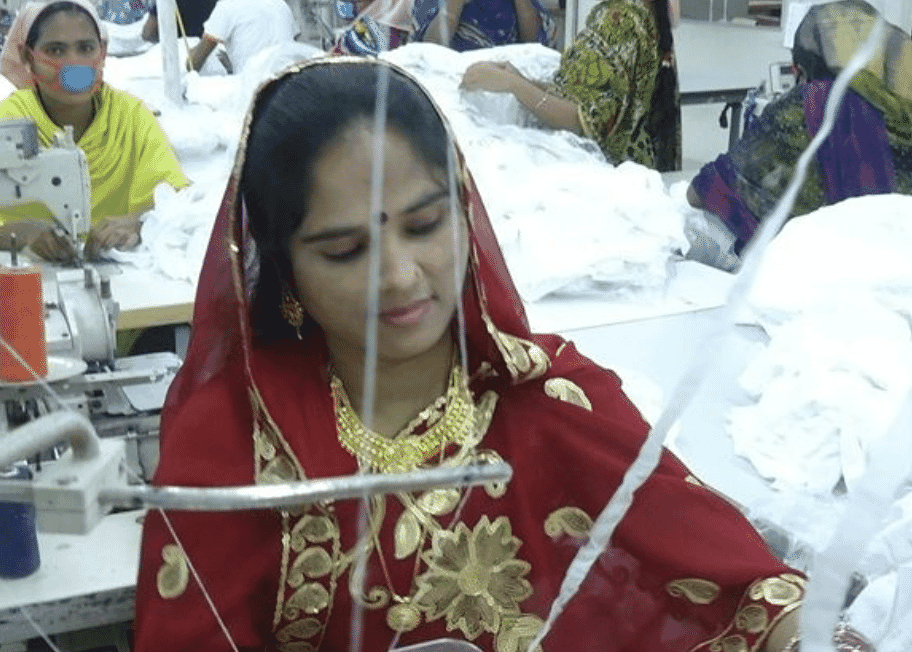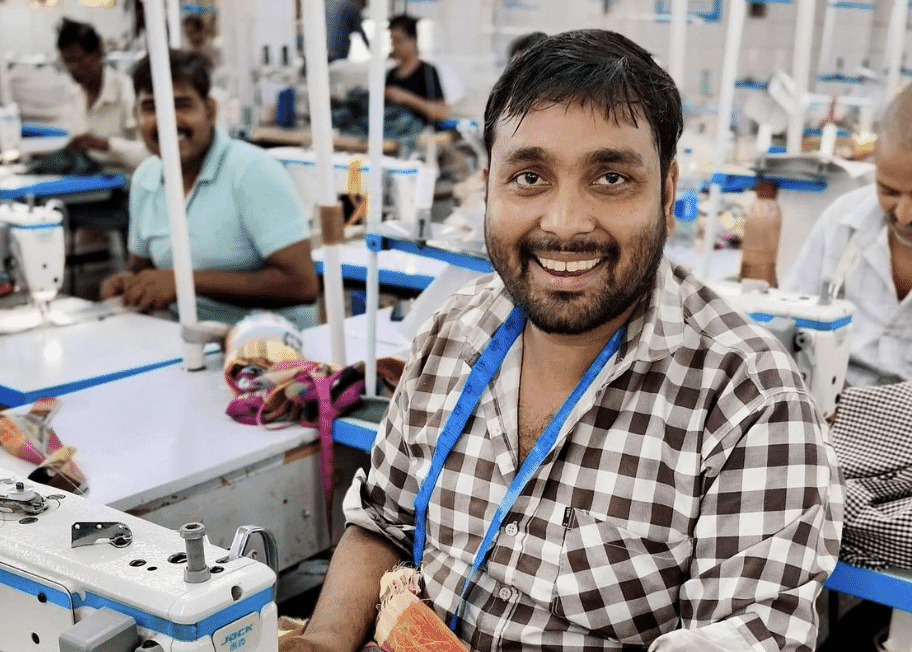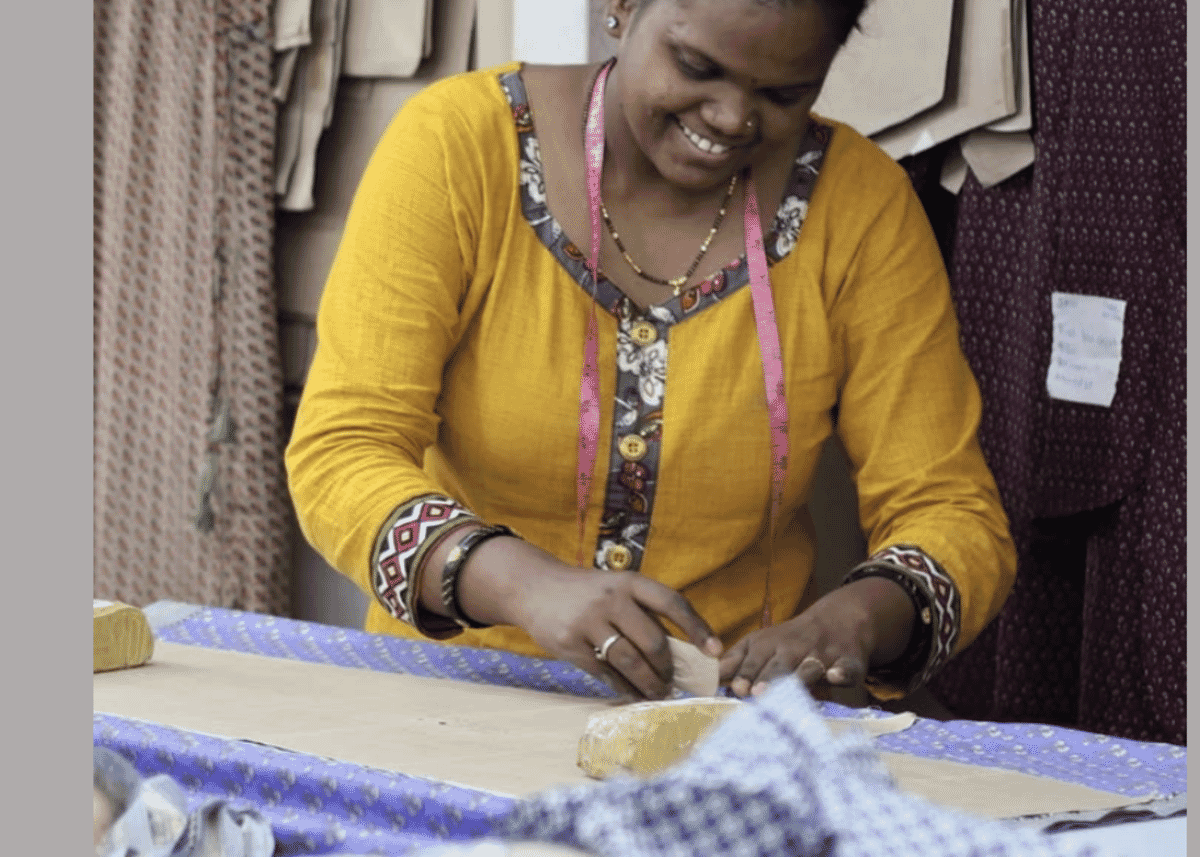
Scarf manufacturers in India sell technique first. Hand block printing, hand weaving, hand embroidery and fine wool work are all practised commercially here, and several of them are protected by name. Sanganeri and Bagru hand block printing, Banaras brocades, Kashmir Pashmina, the Kani shawl and the Kullu and Kinnauri shawls are registered Geographical Indications in India's GI Registry. A scarf is a small piece of cloth, so hand work stays affordable in it in a way it rarely does in a full garment.
India also has the fibre base for it. It is the second largest producer of silk in the world after China and, in the Ministry of Textiles' words, the only country producing all four commercial varieties: mulberry, tasar, eri and muga (Ministry of Textiles, Annual Report 2025-26). The same report puts the handloom sector at 35.23 lakh people working on about 28.23 lakh handlooms, and lists the capability to produce small batch sizes among its strengths.
This guide to scarf manufacturers in India covers where scarves are made and what each technique can and cannot do. It explains what sets a minimum, how to check pashmina, cashmere and silk claims, what US duty applies to a scarf from India, how to specify a scarf, and where scarf programmes go wrong.
Note: India Clothing Factory is a group of documented clothing factories in India, producing garments for brands from 100 pieces per style. Scarves are not one of our listed products: our Jaipur block print and embroidery work is on dresses, tops and shirts. This is an editorial guide to India's scarf centres. We name no scarf makers, and we give no scarf prices or minimums, because those depend on the workshop, the fibre and the design.
Key takeaways
- Scarf centres follow technique: Sanganer and Bagru for block print, Varanasi for brocade, Kashmir for pashmina and Kani weaving, Ludhiana for woollen knitwear.
- Many of these crafts are registered Geographical Indications, which you can look up in India's GI Registry.
- Minimums are set by the technique and the base cloth: printing on stock cloth starts lower than a design woven into the cloth. Ask each workshop for its number.
- Hand work is variable by nature. Agree a range with two sealed samples rather than expecting identical pieces.
- Fibre claims are the main risk. Under US rules, "cashmere" has a legal definition (average fibre diameter no more than 19 microns), and India has a standard, IS 17269, for identifying pashmina.
- US duty on scarves runs from 1.2% to 11.3% depending on fibre and on woven or knitted construction, plus the 10 percent Section 301 tariff on goods of India since 24 July 2026.
- The finished size, the edge construction and the composition clause are the three lines that prevent most scarf disputes.
Where Are Scarf Manufacturers in India Located?
In craft centres, each defined by a technique rather than by a product. The clearest evidence is the GI Registry, where several scarf and shawl crafts are registered to the place that practises them, and the Directorate General of Foreign Trade's list of Towns of Export Excellence, which names towns for the product they export. Choose the centre by technique, then ask each supplier what it makes itself and what it buys in.
| Centre | Technique | Public record |
|---|---|---|
| Sanganer and Bagru, Rajasthan | Hand block printing | GI: Sanganeri Hand Block Printing; Bagru Hand Block Print |
| Jaipur, Rajasthan | Handicrafts, printing and finishing | DGFT Town of Export Excellence for handicrafts |
| Farrukhabad, Uttar Pradesh | Hand printing | GI: Farrukhabad Prints |
| Varanasi, Uttar Pradesh | Hand weaving, brocade, silk | GI: Banaras Brocades and Sarees |
| Kashmir | Pashmina, Kani weaving, sozani embroidery | GI: Kashmir Pashmina; Kani Shawl; Kashmir Sozani Craft. DGFT: Srinagar for handicrafts |
| Kullu and Kinnaur, Himachal Pradesh | Hand-woven wool shawls | GI: Kullu Shawl; Kinnauri Shawl |
| Ludhiana, Punjab | Woollen knitwear | DGFT Town of Export Excellence for woollen knitwear |
| Punjab, Haryana and Rajasthan | Phulkari embroidery | GI: Phulkari |
| Noida, Uttar Pradesh | Apparel production and export | DGFT Town of Export Excellence for apparel products |
Sources: IP India GI Registry (application records), DGFT Foreign Trade Policy Appendix 1B. A GI protects a name and a method in a place; it does not certify any individual workshop.
A GI is worth understanding before you use the name. "Kashmir Pashmina" or "Sanganeri" on a product is a protected geographical name in India, registered to a specific applicant and area. If your product is not made by that method in that area, describe the technique instead of borrowing the name.
Export hubs need a second question. A supplier in an apparel export town such as Noida may do the embroidery and the finishing and buy the base cloth or the printing elsewhere. That can be a perfectly good arrangement, but ask where each step happens, because it decides who you hold to the specification.
Citation Capsule: Indian scarf production is organised by technique. India's GI Registry lists Sanganeri Hand Block Printing and Bagru Hand Block Print (Rajasthan), Farrukhabad Prints and Banaras Brocades and Sarees (Uttar Pradesh), Kashmir Pashmina, Kani Shawl and Kashmir Sozani Craft (Jammu and Kashmir), and Kullu and Kinnauri shawls (Himachal Pradesh). DGFT names Ludhiana a Town of Export Excellence for woollen knitwear and Jaipur and Srinagar for handicrafts.
Related reading: Fabric manufacturers in India · Textile manufacturers in India · Knitwear manufacturers in India · The Indian textile industry
What Can Each Technique Actually Do?
Five techniques cover the scarves this guide deals with, and each has a different relationship between design, minimum and consistency. Choosing the technique is choosing the economics, and it happens at the design stage rather than the sourcing stage.
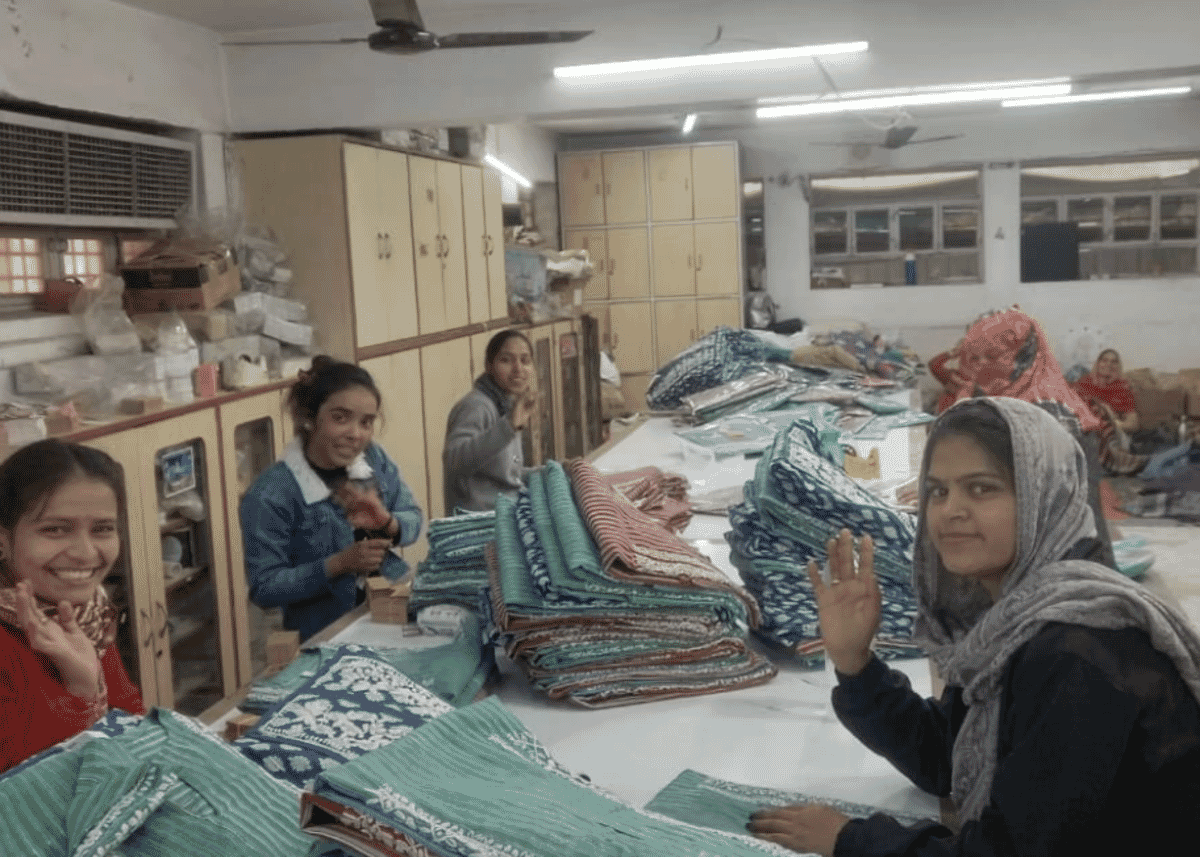
Hand block printing uses carved wooden blocks stamped by hand onto cloth laid on a long table. Each colour is a separate block and a separate pass, so a five-colour design is five blocks and five passes. The set-up is the carving of the blocks, not the engraving of a screen, which is why short runs are possible. Variation between pieces is part of the product rather than a defect.
Hand weaving, including brocade and Kani work, builds the pattern into the cloth on a handloom. It is slow, and the design is fixed once the loom is set, but a woven pattern looks and handles differently from a printed copy of it.
Hand embroidery, such as sozani or phulkari, is added to finished cloth. It is priced by the hours of work in it, and a dense design can take longer than the weaving of the base.
Knitting on flat or circular machines is the usual method for winter mufflers and is what Ludhiana's woollen knitwear cluster does. A knitted scarf is also classified differently at the US border from a woven one, which changes the duty (see below).
Machine printing, screen or digital, puts a design on cloth without hand work. It gives consistent, repeatable product and is the usual choice for volume.
How Do the Printing Methods Compare?
Three of the techniques are printing, and they differ in set-up rather than in skill. That set-up is what sets your minimum, so the choice is commercial before it is aesthetic. Block, screen and digital printing sit at three different points on that curve, and a design drawn for one of them rarely transfers cleanly to another.
Screen printing uses a screen per colour. It is faster and more consistent than block printing, cheaper per piece once the screens exist, and flatter in look: it loses the irregularity people buy block print for.
Digital printing prints photographic and gradient designs with no per-colour set-up. The ink system has to suit the fibre, so name the base cloth (cotton, viscose, silk or polyester) before you ask for a digital price, and ask for a strike-off on that exact cloth.
Block printing sits at the other end: the most hand work per piece, the least set-up, and the most variation. A design with fine detail or many colours costs more blocks and more passes, and asks more of the printer's registration.
Choosing a technique for your design
- Short run, print-led design: hand block print or digital on a stock base cloth
- Simple graphic, repeat orders: screen print, once the screens are paid for
- Photographic or gradient design: digital, with a strike-off on the real cloth
- Design that must be in the cloth: woven or jacquard, and expect a loom set-up
- Winter muffler: knitted, in a woollen knitwear centre
Technique is chosen at the design stage whether or not you choose it. A design that only works woven has set your minimum before anybody has quoted you.
What Sets the Minimum Order for Scarves?
The technique and the base cloth, not the scarf. Anything decorated onto cloth that already exists, by printing or embroidery, starts lower than anything that needs cloth woven or knitted for you, because a loom or a yarn dye lot has its own minimum. That is why we give no single scarf minimum here: two scarves that look alike can carry very different minimums.
For comparison, our own Jaipur block print and embroidery work on garments usually starts at 150 to 300 pieces per style, set by the batch size of the printing table for block print and by the design for embroidery (embroidery and block print in India). The garment underneath adds its own fabric minimum. A scarf workshop sets its own number, so ask for it in writing.
Four questions settle a scarf minimum quickly. Is the base cloth stock, or woven for you? How many colours or blocks does the design need? Is the minimum per design, or per design and colourway? And does the minimum change if you accept a stock colour for the base?
The strategic point for a small brand is to design for decoration rather than for construction. A distinctive print or embroidery on a stock base cloth gives you a distinctive product with a smaller commitment than a woven design, because nobody has to set a loom for you.
Citation Capsule: Scarf minimums in India are set by technique and base cloth. Designs printed or embroidered on stock cloth start lower than designs woven or knitted to order, because a loom set-up or a yarn dye lot carries its own minimum. Ask each workshop whether its minimum is per design or per colourway, and whether a stock base colour lowers it.
Skip the search: the India factory directory ($49) lists documented factories by category, city and capability, with the verification status of each. One-time payment, instant download.
Which Fibre Claims Should You Check?
All of them, and three in particular: pashmina, cashmere and silk. In a scarf the fibre carries much of the price, and the difference between a fine animal fibre and a soft synthetic is hard to tell by hand. These are the three worth testing rather than trusting.
Pashmina is a fine goat undercoat fibre, and the finest, Changthang pashmina, comes from Ladakh. India's Bureau of Indian Standards published IS 17269:2019 for the identification, labelling and marking of pashmina products, and BIS gives the fineness of Changthang pashmina as 12.5 to 14 microns, against 15 to 19 microns for generic cashmere (Bureau of Indian Standards, 2019). The same BIS article puts the finest Ladakh pashmina at less than 1% of global supply, and the standard covers blends with wool, silk, cellulosic and synthetic fibres. The Ministry of Textiles has set up DNA analysers for identifying pashmina products at Leh and Srinagar.
Cashmere has a legal meaning in the United States. Under the Wool Products Labeling Act, a product may be called cashmere only if the fibre is the fine dehaired undercoat of the cashmere goat, its average diameter does not exceed 19 microns, no more than 3% by weight of the cashmere fibres average over 30 microns, and the coefficient of variation around the mean does not exceed 24% (FTC). A cashmere blend is a legitimate product; an unqualified cashmere claim on an unexpectedly cheap scarf is a reason to test.
Shahtoosh is the one name to refuse outright. It comes from the Tibetan antelope, or chiru, and the US Fish and Wildlife Service has prosecuted the sale of smuggled shahtoosh shawls under the Endangered Species Act and CITES; possessing an unlawfully imported one is also illegal (US Fish and Wildlife Service). No legitimate scarf programme uses it.
Silk needs its variety named. India produces mulberry silk and three vanya, or wild, silks: tasar, eri and muga, and they differ in look, handle and price. India's Central Silk Board promotes Silk Mark, through the Silk Mark Organisation of India, as an assurance label that, in the Ministry's words, protects consumers from traders selling artificial silk products in the name of pure silk; 43.45 lakh Silk Mark labels were sold in 2024-25. Its certification centres also carry out pre-shipment inspection of silk goods for export when the exporter requests it (Ministry of Textiles, Annual Report 2025-26).
None of this means the trade is dishonest. The vocabulary is loose and the price difference is large, and a composition clause with a right to test at the seller's cost settles the question before money moves. A flame test on a few pulled threads is a quick first screen, but it is not a result. A laboratory fibre analysis is: AATCC TM20A sets out mechanical, chemical and microscopical procedures for the quantitative fibre composition of textiles (AATCC), and for pashmina, IS 17269 is the Indian reference. The same discipline applies to fabric bought by the metre.
In the US market, the label is the importer's and seller's concern. FTC guidance requires generic fibre names with percentages by weight in descending order, names fibres of 5% or more (wool must be named even below that), and requires imported products to state the country where they were processed or manufactured (FTC). "Pashmina" is not among the fibre names that guidance sets out, so take advice on how a pashmina scarf is labelled for the US. US Customs and Border Protection treats textiles as a priority trade issue because, in its words, high duty rates and complex rules make textile imports susceptible to trade fraud (US Customs and Border Protection).
Fibre verification on a scarf order
- Written composition in the purchase order, with a stated tolerance
- Right to lab-test and reject at the seller's cost if it fails
- Named silk variety (mulberry, tasar, eri or muga) and a Silk Mark label where the seller offers one
- Pashmina tested to IS 17269, and no GI name used unless the product qualifies
- Care and content label written from the tested composition, not from the specification sheet
The vocabulary in this trade is loose rather than dishonest, and a composition clause converts a conversation into a term. It is the most useful line in a scarf purchase order.
How Do You Handle Variation in Hand Work?
By specifying a range rather than expecting identity. Hand block print, hand weave and hand embroidery are variable by nature, and that variation is what the customer is buying. Treating it as a defect produces an inspection that rejects the product for being what it is.
What you can and should specify is the boundary: acceptable registration variation on a block print, acceptable colour variation between pieces, acceptable stitch density variation in embroidery, and what counts as a genuine fault rather than a characteristic. A smudged block, a missed pass, a hole or a broken warp end is a fault. A slight shift in registration or a small change in shade across a dye batch is usually character.
The practical instrument is a pair of sealed samples rather than one: a best-case and a worst-acceptable piece, both signed and kept by each side. Bulk is then judged against the range rather than against a single perfect example, which is the only workable standard for hand work.
Put the dye lot in the same agreement. Natural and hand-mixed dyes shift between batches, so ask how many pieces one batch covers and whether your order will be split across batches. If it will, decide in advance whether batches can be mixed within one shipment or one store.
Citation Capsule: Quality control on hand-produced scarves works by agreeing an acceptable variation range rather than a single standard. Hand block printing, hand weaving and hand embroidery are variable by nature. The workable instrument is two sealed samples, a best case and a worst acceptable, both signed and retained, against which bulk production is judged as a range.
What Drives Scarf Cost and US Duty?
The technique, the fibre and, for the US, the tariff line. A screen-printed viscose stole and a hand-embroidered wool shawl are both scarves and share almost nothing commercially. We give no price bands here, because a quote depends on the workshop, the cloth and the design, but the drivers are predictable.
On printed scarves, the base cloth and the number of colours or blocks drive the price. On woven scarves, the yarn and the weight do. On embroidered pieces, the hours of hand work dominate everything else, so ask how many hours a piece takes before you compare quotes: two quotes that differ by half may describe two different amounts of work rather than two different margins. Hand embroidery is priced by the work in it.
Duty is the cost that is fully public. Scarves have their own tariff headings in the US Harmonized Tariff Schedule: heading 6214 for shawls, scarves and mufflers that are not knitted, and subheading 6117.10 for knitted or crocheted ones. Within each, the rate turns on the fibre (USITC, checked 2 November 2026). India has no preferential rate on these lines, so the general rate applies.
| Scarf fibre | Woven (6214) | Knitted (6117.10) |
|---|---|---|
| Silk, 70% or more by weight | 6214.10.10: 1.2% | 6117.10.40: 1.5% |
| Silk, under 70% | 6214.10.20: 3.9% | 6117.10.60: 9.5%, unless wool or man-made fibre predominates |
| Wool or fine animal hair | 6214.20.00: 6.7% | 6117.10.10: 9.6% |
| Synthetic fibres | 6214.30.00: 5.3% | 6117.10.20: 11.3% |
| Artificial fibres (viscose, modal) | 6214.40.00: 5.3% | 6117.10.20: 11.3% |
| Cotton and other | 6214.90.00: 11.3% | 6117.10.60: 9.5% |
General rates from the USITC Harmonized Tariff Schedule, checked 2 November 2026. Add the 10 percent Section 301 tariff on goods of India (9903.05.44). Confirm the classification for your exact product.
Since 24 July 2026, a 10 percent Section 301 tariff applies to goods of India generally, unless a product is exempted (USTR, July 2026). It sits on top of the ordinary rate, so a woven wool scarf from India pays 6.7% plus 10%. The 18 percent reciprocal tariff announced in the joint statement of 6 February 2026 (The White House, 2026) no longer applies: it rested on IEEPA, which the Supreme Court held on 20 February 2026 does not authorise tariffs (Supreme Court of the United States).
Two practical points follow. First, the composition you write into the purchase order also decides the tariff line, so a blend has to be classified by the fibre that predominates by weight. Second, knitted or woven is a design decision with a duty consequence: a winter muffler can be made either way, and the rate differs. Scarves are light, so freight is rarely the main cost; our guide to shipping from India to the USA covers the options.
No tech pack yet? Factories quote from specifications, not from photographs. A factory-ready single-style tech pack is $79: measurements, construction, fabric, trims and labelling in the format an Indian factory costs from.
How Do You Specify a Scarf?
With six fields, and two of them are the ones most easily left open: the finished size after washing and the fringe or hem construction. Finished size matters because scarf fabrics, particularly loosely woven wool and cotton, can shrink and relax in finishing. If you write 70 by 200 centimetres and do not say whether that is before or after washing, a scarf that arrives a few centimetres short in each direction has met the specification, and the argument is yours to lose.
Weight is the second field that needs a basis. Fabric mass per unit area has a published test method (ASTM D3776), so a weight in grams per square metre is a number a workshop can be held to rather than a description such as "light" or "heavy". For silk, the trade unit is the momme; state which one you mean.
Why Does the Edge Finish Matter So Much?
Because it is the part of a scarf a customer handles, and the part a workshop will simplify if you let it. On a hand-finished piece the edge is also a real share of the labour, which is why an unspecified edge tends to get cheaper rather than better.
The fringe or hem is the detail customers examine and often the first to fail. Hand-knotted fringe, twisted fringe, cut fringe, a hand-rolled hem and a machine-rolled hem are different products at different costs. Name the one you want, with its length or width, and ask for it on the sealed samples.
Six lines every scarf specification needs
- Fibre composition with tolerance and a right to test
- Fabric weight in g/m², or momme for silk
- Finished size after washing and finishing, with a tolerance
- Edge construction: hand-knotted, twisted, cut fringe or rolled hem, with length
- Technique and colour count, since both drive the minimum and the price
- Acceptable variation range for any hand-produced element
The finished-size line prevents the most avoidable size dispute and the edge line the most visible quality complaint. Neither costs anything to write.
Citation Capsule: A complete scarf specification contains six fields: fibre composition with tolerance and a right to test; fabric weight in grams per square metre, or momme for silk; finished size measured after washing and finishing; edge construction naming the fringe or hem type and its length; technique with colour count; and an acceptable variation range for hand-produced elements.
Where Do Scarf Programmes Fail?
Four failures recur, and three of them are specification gaps rather than manufacturing faults: fibre not as described, size drifting after finishing, and edge quality. The fourth is colour variation treated as a defect when it is inherent, or a defect excused as variation.
Fibre not as described. Covered above. It is the failure with the largest commercial consequence, because the fibre carries the price and, in the US, decides both the label and the duty.
Size after finishing. Specify the finished size, not the greige size, and require it measured after washing.
Edge quality. Fringes unravel and rolled hems come undone when neither was specified. Name the construction and the stitch, as the finishing stage requires for any garment.
Colour variation treated as a defect, or a defect treated as variation. Both happen when no acceptable range was agreed. Two sealed samples solve it.
How Do You Choose Between Scarf Manufacturers in India?
Start from the technique and go to the centre that practises it: block print in Sanganer, Bagru and Jaipur, brocade in Varanasi, pashmina and Kani weaving in Kashmir, hand-woven wool shawls in Kullu and Kinnaur, knitted mufflers in Ludhiana. Then ask each supplier which steps it does itself and which it buys in. A supplier that coordinates several workshops can be useful; you just need to know who holds the specification at each step.
Design for decoration rather than construction if your volumes are small. A distinctive print or embroidery on a stock base cloth gives you a distinctive product without a loom set-up.
Ask how long a hand-worked piece takes before comparing prices. The hours answer makes the comparison meaningful in a way the price alone does not.
Check the paperwork that exists. A GI name should only be used for a product that qualifies, a silk claim can carry a Silk Mark label, and a pashmina claim can be tested to IS 17269. And put the composition, the finished size and the edge construction in writing. Those three lines prevent the disputes that cause most of the trouble in this category.
Frequently Asked Questions
Where are scarves made in India?
By technique rather than by product. Hand block printing is centred on Sanganer, Bagru and Jaipur in Rajasthan, brocade weaving on Varanasi, pashmina, Kani weaving and sozani embroidery on Kashmir, hand-woven wool shawls on Kullu and Kinnaur, and woollen knitwear on Ludhiana. Several of these crafts are registered Geographical Indications.
What is the minimum order for scarves in India?
It depends on the technique and the base cloth, so ask each workshop. Designs printed or embroidered on stock cloth start lower than designs woven or knitted to order, because a loom set-up or a yarn dye lot carries its own minimum. Ask whether the minimum is per design or per colourway.
How do I check a pashmina or cashmere claim?
With a laboratory fibre test, not a conversation. In the US, cashmere must average no more than 19 microns under the Wool Products Labeling Act. India's IS 17269 covers the identification of pashmina products. Put a composition clause in the purchase order with a right to test and reject at the seller's cost.
What US duty applies to scarves from India?
Woven scarves fall under HTS heading 6214 and knitted ones under 6117.10. General rates run from 1.2% for woven silk to 11.3% for woven cotton or knitted man-made fibres, and woven wool is 6.7%. A 10 percent Section 301 tariff on goods of India applies on top since 24 July 2026.
What should be in a scarf specification?
Fibre composition with a tolerance and a right to test, and fabric weight in grams per square metre or momme for silk. Then finished size after washing, with a tolerance. Then edge construction naming the fringe or hem type and length, technique and colour count, and an acceptable variation range for hand work.
Scarves are not one of our listed products. If your range includes clothing, including block-printed or embroidered dresses, tops and shirts, tell us the garment and the quantity: our team replies within 24 hours, then we place it with the factory in our group built for it, from 100 pieces per style. If no factory in our group is built for your product, we tell you by email before any fee is discussed. No commissions. No markups. The factory bills you directly.
Get in contact Download the directory ($49)Need a tech pack? Get a factory-ready single-style tech pack for $79. See what's included.
Editorial note: all company names, certification marks and trademarks referenced here are the property of their respective owners. Geographical Indications are cited from India's GI Registry and do not endorse any workshop. Our group makes clothing; this guide names no scarf makers and gives no scarf prices or minimum quantities. Duty figures are as USITC and USTR state them (checked 2 November 2026) and the 2026 position is still moving. Always verify your own HTS classification and confirm terms directly with the workshop before committing.
Sources
- Ministry of Textiles, Government of India: Annual Report 2025-26 (handloom sector, 35.23 lakh people and 28.23 lakh handlooms; raw silk production by variety, 41,121 MT in 2024-25; Silk Mark; Pashmina Wool Development Scheme and DNA analysers at Leh and Srinagar).
- IP India GI Registry: Sanganeri Hand Block Printing (application 147); also Bagru Hand Block Print (183), Farrukhabad Prints (234), Banaras Brocades and Sarees (99), Kashmir Pashmina (46), Kani Shawl (51), Kashmir Sozani Craft (48), Kullu Shawl (19), Kinnauri Shawl (149) and Phulkari (27).
- Directorate General of Foreign Trade: Appendix 1B, Towns of Export Excellence (Ludhiana, woollen knitwear; Jaipur and Srinagar, handicrafts; Noida, apparel products).
- Bureau of Indian Standards: Pashmina, telling the real from the fake (9 August 2019), on IS 17269:2019 and pashmina and cashmere fineness.
- Federal Trade Commission: Threading Your Way Through the Labeling Requirements Under the Textile and Wool Acts (cashmere definition, fibre names and percentages, country of origin).
- US Fish and Wildlife Service: Shahtoosh dealers plead guilty in landmark case (10 July 2000).
- AATCC: TM20A-2025, Test Method for Fiber Analysis: Quantitative.
- US Customs and Border Protection: Textiles and wearing apparel priority trade issue.
- USITC Harmonized Tariff Schedule: heading 6214 and subheading 6117.10 general rates, and 9903.05.44 (+10% on products of India); checked 2 November 2026.
- Office of the United States Trade Representative: Notice of actions in the forced labor Section 301 investigations, July 2026 (10 percent on goods of India from 24 July 2026).
- The White House: United States-India Joint Statement of 6 February 2026, announcing the 18 percent reciprocal tariff under Executive Order 14257, an IEEPA order.
- Supreme Court of the United States: Learning Resources, Inc. v. Trump, decided 20 February 2026 (IEEPA does not authorise tariffs).
- ASTM International: D3776/D3776M, test methods for mass per unit area, the published basis of a fabric weight specification.