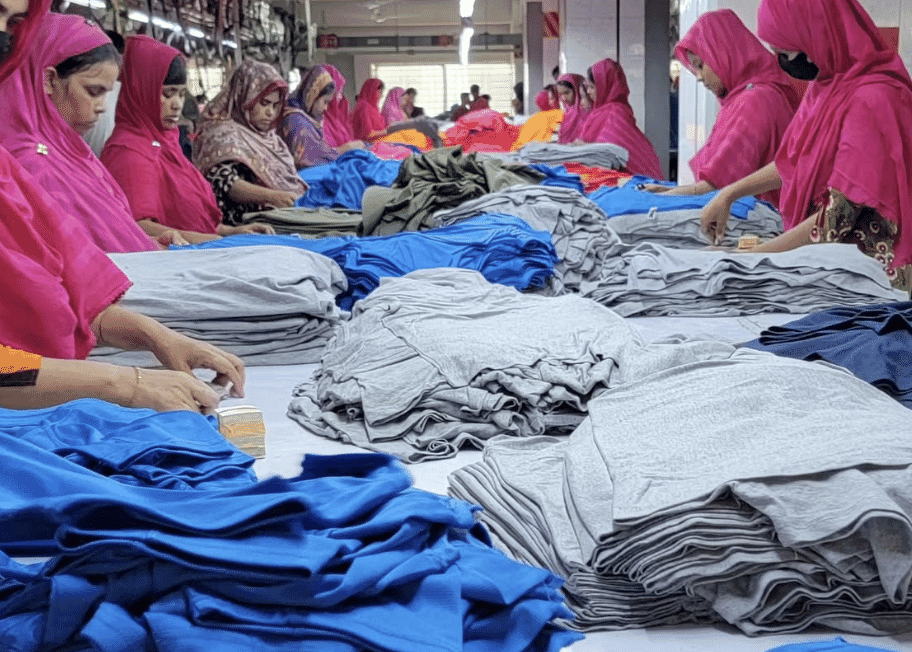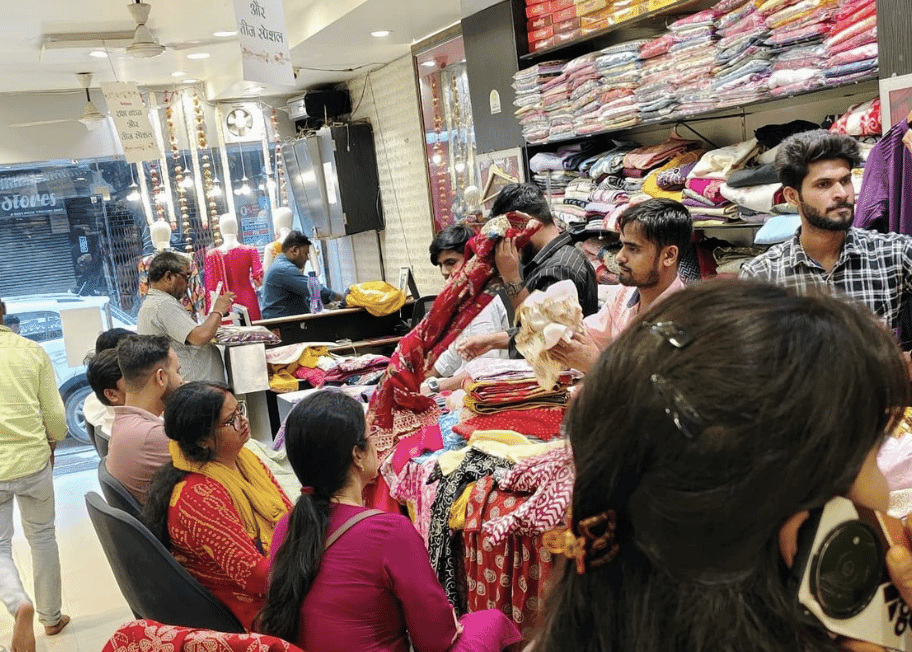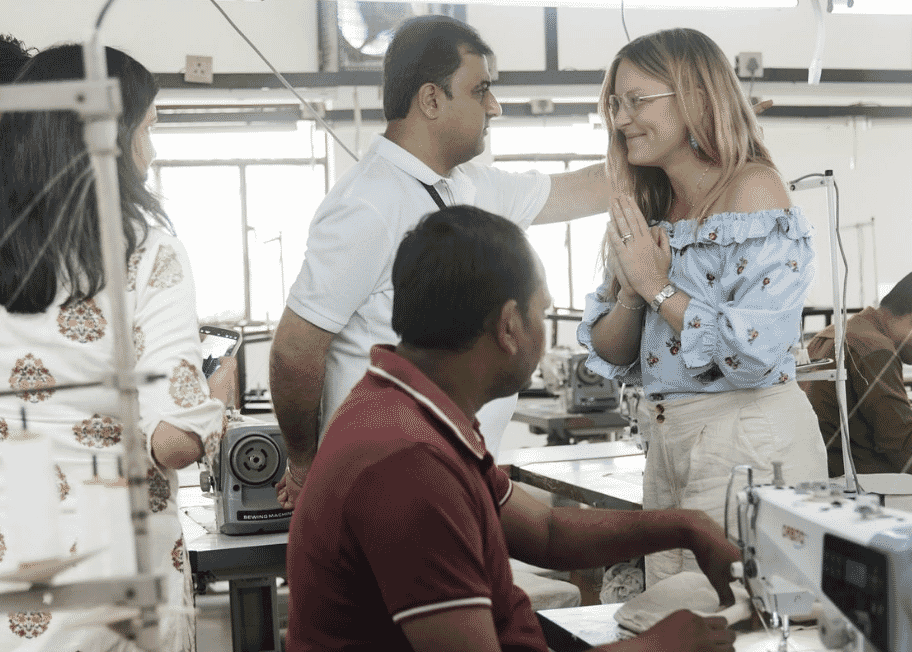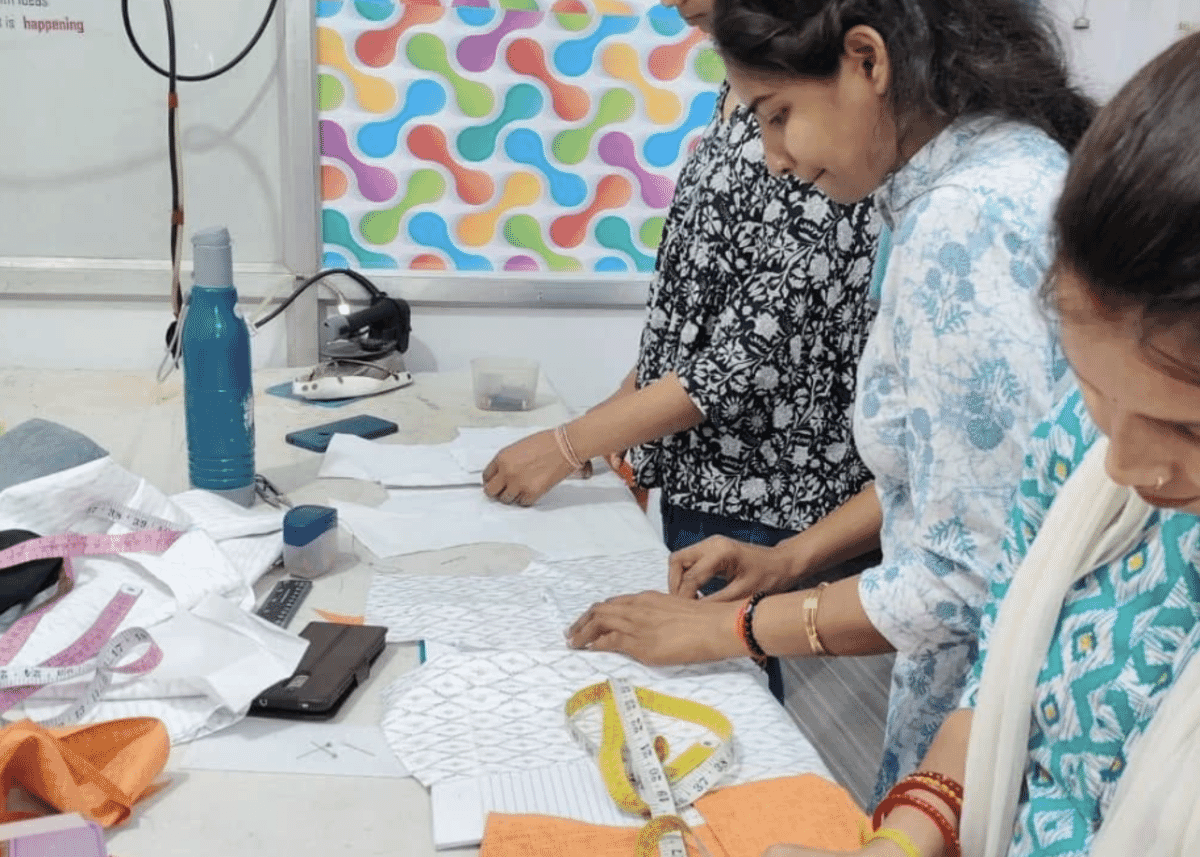
Dress manufacturers in India work in the category where three separate skills have to come together: a mill that makes the cloth, a pattern room that makes the shape, and a grader who makes the size range. A dress is usually a woven garment with a fitted shape. The fabric decision therefore sits at a mill, the pattern work is genuinely skilled, and the grading is harder than in any knit product. Get those three right and India is an excellent source. Get any of them wrong and you have a beautiful sample and an unsellable bulk.
The country's real advantage here is not price. It is the combination of printed and embellished fabric, hand work, and a viscose and cotton supply chain. Together those produce the soft-drape product a great deal of the market wants. Garments are also what India exports most: ready-made garments were 42.4% of the country's textile and apparel exports in 2024-25 (Ministry of Textiles).
This guide to dress manufacturers in India covers where dresses are made and what minimums the fabric imposes. It sets out the US duty on dresses by fibre, what a US label has to carry, how sizing and grading go wrong, what a dress specification needs, and where the category is the wrong choice.
Note: India Clothing Factory is a group of documented clothing factories in India, producing garments for brands from 100 pieces per style. Dresses on stock fabric start at about 300 pieces per style in our group, because woven fabric sets the floor. Minimums, sampling times and lead times in this guide are our own published figures; duty, labelling and export figures come from the official sources cited. We confirm exact MOQ and price with the factory when you send a brief.
Key takeaways
- Dresses are mostly woven garments, so the fabric sets the minimum rather than the sewing line.
- In our group, stock fabric puts a dress at about 300 pieces per style. Fabric woven or printed for you pushes it to around 1,000.
- Delhi NCR and Jaipur are the principal making centres. Gurgaon and Noida are listed Towns of Export Excellence for apparel.
- US duty on a dress turns on the fibre: a woven cotton dress is 8.4%, a woven viscose or polyester dress 16%, plus the 10% Section 301 tariff on goods of India.
- Grading is the hidden risk. A dress that fits the base size can fail across the range.
- A US dress label needs fibre content, country of origin, the responsible company and care instructions, and light cellulosic fabrics fall inside the clothing flammability standard.
- Expect 12 to 16 weeks from approved sample to shipment on a first order, and plan around Diwali (8 November in 2026).
Where Are Dress Manufacturers in India Located?
Principally in Delhi NCR and Jaipur, with fabric coming from Gujarat and embellishment from a subcontracted tier that sits alongside both. The geography is worth understanding because the fabric and the making happen in different places. The public record supports the outline: India's Directorate General of Foreign Trade lists Gurgaon and Noida as Towns of Export Excellence for apparel, Jaipur for handicrafts and Ahmedabad for textiles (DGFT, Appendix 1B).
Delhi NCR, covering Noida, Gurgaon and Okhla, is the country's principal woven garment cluster and the deepest source of pattern and sampling skill. It is also where most embellishment and hand-embroidery capacity sits and where international buying offices are concentrated. Our page on clothing manufacturers in Delhi NCR covers the cluster in more detail.
Jaipur handles block-printed, natural-dyed and craft-led dresses, and it is where a print-led product with a distinctive hand is most credibly made. Two of its printing traditions are registered Geographical Indications, Sanganeri Hand Block Printing and Bagru Hand Block Print (IP India GI Registry). Minimums there are often lower because the value is added to stock cloth.
Bangalore makes structured and formal wovens for larger programmes. It suits a shirt dress or a tailored day dress at volume better than a small, embellished run.
Ahmedabad and Surat supply the fabric rather than the garment. Ahmedabad is a listed textile town and Surat is a major market for man-made fibre fabric; our guide to the Surat textile market explains how it works. A dress unit in Delhi buying viscose from Surat means your fabric lead time includes an inland movement that a quotation rarely mentions.
Citation Capsule: Dress manufacturing in India is concentrated in Delhi NCR, covering Noida, Gurgaon and Okhla, which holds the deepest woven pattern and sampling capability. Gurgaon and Noida are DGFT-listed Towns of Export Excellence for apparel. Jaipur is the secondary cluster, for block-printed and craft-led product, with Sanganeri and Bagru hand block printing registered as Geographical Indications. Fabric comes principally from Gujarat, so fabric lead times include inland movement between clusters.
Related reading: Clothing manufacturers in India · Fabric manufacturers in India · The Surat textile market · Shirts and dresses made in India · Workwear manufacturers in India
How Large Is India's Garment Export Base?
Large enough that a dress programme is ordinary business rather than a specialist request. India's textile and apparel exports, including handicrafts, were US$37,755 million in 2024-25, up 5% on the year before, and the country ranked as the sixth largest exporter of textiles and apparel in 2024 with a 4.1% share of world trade (Ministry of Textiles, Annual Report 2025-26).
Within that total, ready-made garments are the largest single category. The Ministry's breakdown, based on DGCI&S trade data, is shown below. Man-made textiles, which include the viscose and polyester fabrics that so many dresses use, were a further 14.0%, and exports of man-made fibre textiles and apparel together came to US$8.5 billion.
The scale matters for a practical reason. A country that exports this much clothing has the supporting trades a dress needs, from trims and zips to testing laboratories and freight forwarders, within reach of the main clusters. What it does not guarantee is that any single factory is right for your dress. That still comes down to the fabric, the pattern room and the grading, which the rest of this guide covers.
What Minimums Apply to Dresses?
In our group, about 300 pieces per style on stock fabric, and around 1,000 where the fabric is woven or printed for you. This is the standard woven picture and it catches brands who arrived from knitwear expecting a hundred. Ask which fabrics the factory or its mill already holds before deciding what minimum you can accept.
| How the fabric is sourced | Minimum per style in our group | What sets it |
|---|---|---|
| Stock fabric the mill or factory already holds | About 300 pieces | The roll length of the stock cloth |
| Fabric woven or printed for you | Around 1,000 pieces | The mill's own minimum run |
| Block print or embroidery added to stock cloth | 150 to 300 pieces | The hand-work batch rather than the fabric |
Our own published figures for shirts and dresses and for embroidery and block print. The factory confirms the exact number after reading your brief.
The third row is the way around the floor. Block print and hand embroidery both add value to cloth that already exists, so a distinctive dress at 150 to 300 pieces is achievable when a dress in a fabric woven to your design is not. Our page on embroidery and block print in India covers that work.
The arithmetic behind the floor is simple once you see it. A mill's minimum is set in metres, not in garments. Your dress consumes a certain length of fabric per piece, depending on the pattern, the size range and the cuttable width, so the mill's minimum divided by your consumption gives the smallest order that does not leave you paying for cloth you cannot use. A full-skirted or bias-cut dress uses more fabric than a straight shift, so the same mill minimum covers fewer of them. Ask the factory for the consumption figure from the marker, not an estimate.
Citation Capsule: Dress minimums in India are set by how the fabric is sourced. In India Clothing Factory's group, a dress on stock fabric starts at about 300 pieces per style, and fabric woven or printed for the brand pushes the minimum to around 1,000, the mill's own run. Where the design is added to stock cloth by block printing or hand embroidery, the group's range is 150 to 300 pieces.
Which Fabrics Suit Indian Dress Production?
Viscose and rayon above all, then cotton in every construction, then blends. India's strength in soft-drape man-made cellulosics is genuine and it suits a large share of what the dress market wants. Viscose quality variance is the thing to manage. Two fabrics sold as viscose rayon at similar prices can differ substantially in yarn quality, drape and dimensional stability. The difference appears after washing rather than in the sample room. Specify weight, construction and shrinkage rather than accepting a description.
The name on the label is settled. Under the US Textile Act rules the generic name is rayon, and because the ISO standard uses the name viscose for the predominant form of rayon, the Federal Trade Commission accepts either name (FTC). Lyocell is listed as a form of rayon in the same rules. Write the fibre name into the purchase order exactly as it will appear on the label, so the factory, the label maker and the customs entry all use the same word.
Where Does Cotton Fit in a Dress Range?
It is the dependable half of the fabric decision, and the half where certification is realistic. Viscose carries the drape a dress range usually wants. Cotton carries the supply chain that can be documented end to end, which matters the moment a claim goes on a hangtag.
Cotton is reliable and well understood, and it is where certified organic supply is available if the product needs it (GOTS). Linen is possible with imported flax at a higher price and a longer lead time.
What India does not do well in this category is technical or performance-treated woven fabric. Any dress whose fabric carries an engineered claim will be made from imported cloth.
Printed and deep-dyed cloth also carries a substance-testing question that plain cloth does not, and Standard 100 is the instrument most retailers ask for (OEKO-TEX). It is worth settling who holds that certificate before a print range is developed rather than after.
Fabric questions to settle before sampling a dress
- Weight in g/m² with a tolerance, because drape follows weight
- Shrinkage after a named wash cycle, tested on bulk rather than on the swatch
- Cuttable width, which changes consumption and therefore cost per garment
- Whether the fabric is stock or woven for you, since that is your minimum
- Fibre content by weight, since it decides both the label and the US tariff line
- Colour fastness on deep shades and prints, to washing and to rubbing
Every one of these belongs in the enquiry rather than in the sample review. A dress sampled in a substitute fabric tells you about the pattern and nothing about the product.
What US Duty Applies to Dresses From India?
Between 0.9% and 16% at the general rate, depending on the fibre and on whether the dress is woven or knitted, plus a 10 percent Section 301 tariff on goods of India. Women's and girls' dresses have their own tariff lines in the US Harmonized Tariff Schedule: subheadings 6204.41 to 6204.49 for woven dresses and 6104.41 to 6104.49 for knitted ones (USITC, checked 3 November 2026). India has no preferential rate on these lines, so the general rate applies.
| Dress fibre | Woven (6204) | Knitted (6104) |
|---|---|---|
| Cotton | 6204.42.30: 8.4% | 6104.42.00: 11.5% |
| Cotton, certified hand-loomed and folklore | 6204.42.10: 11.8% | n/a |
| Cotton with 36% or more flax | 6204.42.20: 5.5% | n/a |
| Artificial fibres (viscose, modal, lyocell) | 6204.44.40: 16% | 6104.44.20: 14.9% |
| Synthetic fibres (polyester, nylon) | 6204.43.40: 16% | 6104.43.20: 16% |
| Wool or fine animal hair | 6204.41.20: 13.6% | 6104.41.00: 13.6% |
| Silk, 70% or more by weight | 6204.49.10: 6.9% | 6104.49.10: 0.9% |
General rates from the USITC Harmonized Tariff Schedule, checked 3 November 2026. Add the 10 percent Section 301 tariff on goods of India (9903.05.44). Confirm the classification for your exact product.
Since 24 July 2026, a 10 percent Section 301 tariff applies to goods of India generally, unless a product is exempted (USTR, July 2026). It sits on top of the ordinary rate, so a woven cotton dress from India pays 8.4% plus 10%, and a woven viscose dress 16% plus 10%. The 18 percent reciprocal tariff announced in the joint statement of 6 February 2026 (The White House, 2026) no longer applies: it rested on IEEPA, which the Supreme Court held on 20 February 2026 does not authorise tariffs (Supreme Court of the United States).
Three practical points follow. First, the composition you write into the purchase order also decides the tariff line, so a blend is classified by the fibre that predominates by weight. A cotton-viscose dress is a cotton dress at 8.4% if cotton is the larger share and a viscose dress at 16% if it is not. Second, the cheapest-looking fabric on a cost sheet can be the more expensive one landed, because the duty difference between cotton and viscose is larger than many fabric price differences. Third, "certified hand-loomed" is a classification that needs certification; it does not lower the rate on a cotton dress, it raises it to 11.8%. Our guide to shipping from India to the USA covers freight and customs entry.
Citation Capsule: US general duty on women's dresses depends on fibre and construction. Under HTS heading 6204, a woven cotton dress is 8.4% and a woven viscose or polyester dress 16%; under 6104, a knitted cotton dress is 11.5% and a knitted viscose dress 14.9%. Since 24 July 2026 a 10 percent Section 301 tariff applies on top for goods of India, so fibre content in the purchase order is also a landed-cost decision.
What Must a Dress Label Carry in the US?
Fibre content, country of origin, the identity of the responsible company, and care instructions, with one more test for lightweight fabrics. These are legal requirements on the importer, not retailer preferences, and they are cheapest to get right before the labels are woven in India.
Fibre content and origin. The FTC's Textile Act rules require fibre content by generic name and percentage, the country of origin, and the identity of the manufacturer or another responsible business (FTC). Imported products must name the country where they were processed or manufactured. On a garment with a neck, the origin has to be disclosed on the front of a label at the inside centre of the neck. Fibres under 5% are disclosed as "other fiber" unless they have a functional significance, such as elastane in a stretch dress.
Care. The FTC Care Labeling Rule applies to manufacturers and importers of textile wearing apparel. The label must be permanent and legible for the life of the garment, give regular care instructions or warn where the garment cannot be cleaned without damage, and rest on a reasonable basis (FTC). For a printed viscose dress with deep shades, a reasonable basis usually means a wash test, not an assumption.
Flammability. The US Standard for the Flammability of Clothing Textiles, 16 CFR Part 1610, applies to clothing and to textiles intended for clothing. It exempts plain-surface fabrics of 2.6 ounces per square yard or more, and fabrics made entirely of acrylic, modacrylic, nylon, olefin, polyester or wool (16 CFR 1610.1). A light viscose voile, a sheer cotton lawn or a brushed surface is therefore inside the standard, which is exactly the fabric a summer dress range tends to use. Ask whether the fabric has a 1610 result before you approve it.
The dress label checklist
- Fibre content by generic name and percentage, matching the purchase order
- Country of origin: "Made in India" on the neck label's front
- Your identity: company name or RN
- Care instructions you have a reasonable basis for
- Flammability: a 1610 result for light or raised-surface fabrics that are not exempt
A label woven wrong in India is a relabelling job in the US. Send the label artwork with the tech pack and approve a printed sample.
Why Does Grading Cause So Many Problems?
Because a fitted woven garment does not scale linearly, and the sample that fits the base size perfectly can fail two sizes either side of it. This is one of the most common and expensive failures in dress production, and it is preventable.
Bodies do not grow proportionally. A larger size needs proportionally more at the bust and waist than at the shoulder and neck. A linear grade rule, which is what you get when nobody specifies otherwise, produces garments that fit progressively worse as they move away from the base.
Published body measurement tables exist precisely because the relationship between sizes is not linear. They are what a grade rule should be built against, rather than invented from (ASTM D5585). Ask which table your factory graded to, and whether it matches the market you are selling into.
The instrument is a size set: one garment in every size, made in bulk fabric, fitted before production. It adds a fitting round to the schedule, and it is the sample most often skipped under schedule pressure.
Citation Capsule: Grading is a principal fit risk in dress production, because fitted woven garments do not scale linearly. Larger sizes require proportionally more at the bust and waist than at the shoulder and neck. A linear grade rule, which applies by default when unspecified, produces progressively poorer fit away from the base size. A size set, one garment per size in bulk fabric, is the control.
No tech pack yet? Factories quote from specifications, not from photographs. A factory-ready single-style tech pack is $79: measurements, construction, fabric, trims and labelling in the format an Indian factory costs from.
Grading problems in dresses are more visible than in other categories, because the garment is fitted at several points at once. An error that would be invisible in a tee shows up as a shoulder that pulls or a waist that sits wrong. The fix is to approve fit on more than one size. Approving the base size alone and letting the factory grade outward is how a range passes sampling and fails at retail.
What Construction Details Drive Cost?
Lining, closures, interfacing and finishing, in roughly that order. A dress is a garment with a large number of decisions inside it, and each one is made by somebody whether or not it is specified. Specify all four and the quote becomes comparable between factories.
How Much Does Lining Actually Add?
Enough to change the commercial case for a style, because a lined dress is two garments assembled together rather than one. The lining is a second fabric, a second cutting operation and a second set of seams, and it is the single largest construction decision in the category.
Half-lining, which lines the bodice only, often delivers most of the benefit for less. It is worth asking the factory to quote both ways before the range is fixed, so the difference is a number rather than a guess.
| Element | Effect on cost | What to specify |
|---|---|---|
| Lining | High. Fabric plus a second assembly | Full, part or unlined, and the lining fabric itself |
| Closures | Moderate to high | Zip type and length, button type, or none |
| Interfacing | Low cost, high consequence | Weight and placement, since it governs collar and facing behaviour |
| Seam finishing | Moderate | Overlocked, bound or French, named per seam |
| Hem | Moderate | Blind stitch, machine hem or hand finish |
| Embellishment | Can exceed the garment | Placement, density and hours, with a sample |
A qualitative guide from our team. The factory's quote, line by line, gives the actual figures for your style.
Ask for the quote broken down the same way as this table. When two factories quote the same dress and differ, a line-by-line quote shows whether the difference is in the lining, the trims or the hours of hand work, rather than in the margin. Embellishment in particular is priced by the hours in it, so ask how many hours a piece takes before comparing quotes.
How Long Does a Dress Programme Take?
In our group, sampling takes three to five weeks, longer if the fabric is woven for you, and a first bulk order takes 12 to 16 weeks from approved sample to shipment. Repeat orders take eight to ten weeks. Dresses take longer than knits because the fabric is woven and the pattern work is heavier.
The critical path is fabric. Stock fabric still has to move from Gujarat to the making unit, and anything woven or printed for you adds the mill's own schedule. Ask your factory for the fabric delivery date, because that date predicts your shipment and the shipment date does not.
Festivals sit inside the calendar too. Diwali is a gazetted holiday on 8 November 2026 (Government of India, gazetted holidays 2026), and its date moves each year with the lunar calendar. Each factory sets its own closure around the festival, so ask for those dates in writing and build them into the schedule rather than discovering them in it.
Building a realistic dress schedule
- Sampling: 3 to 5 weeks in our group, including fit rounds; add the size set
- Fabric: the critical path; ask for its delivery date at the making unit
- Embellishment: ask for its own date, since it is often subcontracted
- First bulk: 12 to 16 weeks from approved sample to shipment; repeats 8 to 10
- Festivals: each factory's Diwali closure dates, in writing
The size set is the step most often cut and the one that prevents the most expensive failure. Cutting it saves a fitting round and risks a whole range.
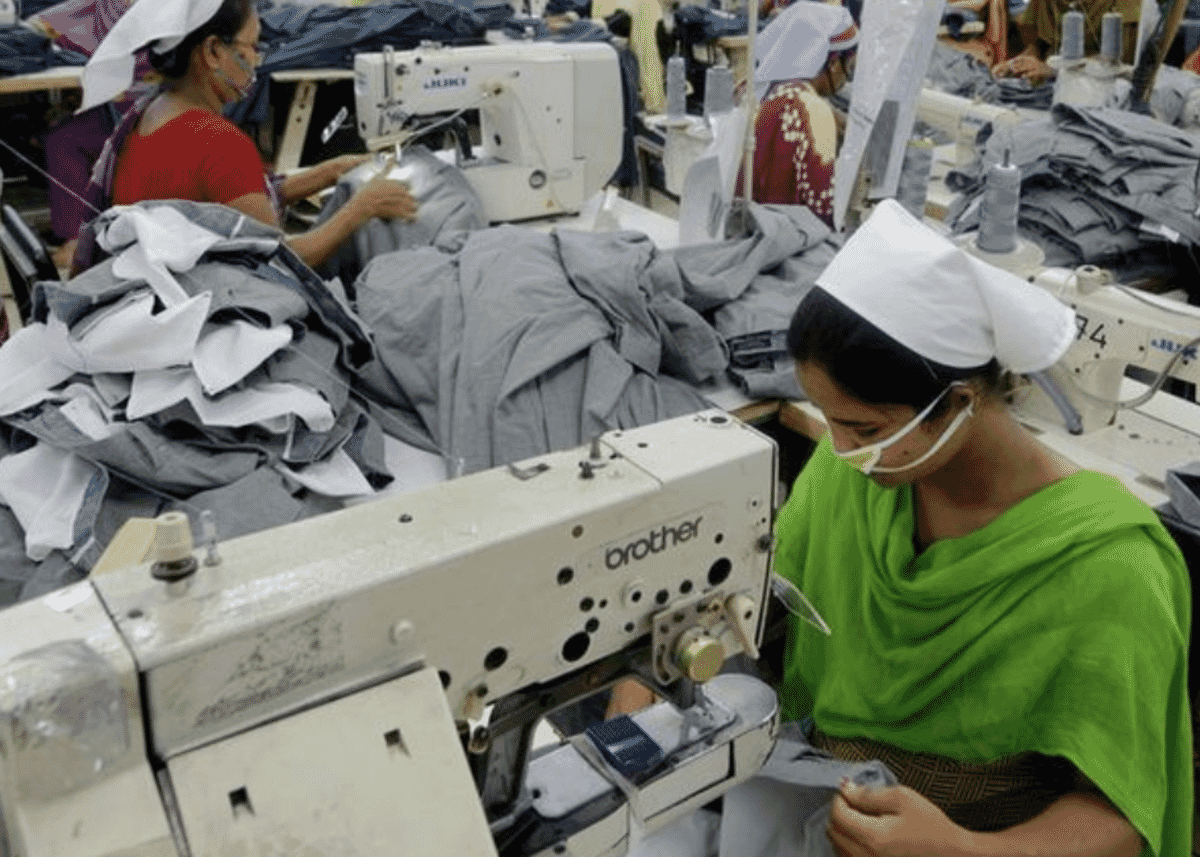
A dress programme takes longer than the sewing suggests because the fabric, the lining and any embellishment arrive on three different schedules and the slowest sets the date. Build the critical path from the embellishment where there is any, since hand work is batched by the availability of the people doing it rather than by machine capacity. Ask for the three delivery dates separately rather than accepting a single production start.
Where Dress Programmes Fail
Four failures, and two of them are fabric problems wearing a fit costume. They are grading across the range, shrinkage moving the measurements after wash, drape behaving differently in bulk than in the sample, and embellishment inconsistency. The middle two are the fabric problems.
Grading across the range. Covered above, and it is the one that produces returns rather than rejections, because the garments pass inspection and fail on customers.
Shrinkage moving the measurements. A dress that measured correctly before washing and fails after it has a fabric problem discovered in a finished garment. Test shrinkage on bulk before cutting, against a named method and its conditioning practice, since results move with the atmosphere the sample was held in (ASTM D1776).
Drape different in bulk. A sample made in a substitute fabric and a bulk made in the specified one can hang completely differently. The pre-production sample in bulk fabric is the only sample that predicts this.
Embellishment inconsistency. Hand work varies, and without an agreed acceptable range the inspection either rejects good work or accepts poor work. Seal two samples, one at each end of the acceptable range, and inspect against both.
Citation Capsule: Dress production failures concentrate in four areas. Grading across the size range produces customer returns rather than inspection rejections, and shrinkage moves finished measurements outside tolerance. Drape differs between a sample made in substitute fabric and bulk made in the specified fabric. The fourth is inconsistency in subcontracted embellishment where no acceptable variation range was agreed.
When Is India the Wrong Choice for Dresses?
Three situations. Where the fabric carries an engineered or performance claim, since that cloth is imported. Where you need a very short lead time, because woven fabric alone can take longer than the deadline. And where the product is a plain, price-led dress at very high volume with tight tolerance, where a large single-site factory elsewhere may be the simpler choice.
Where India is right it is strongly right. That means printed and embellished dresses, soft-drape viscose and rayon, and block print and craft-led product. It also means anything where hand work is part of the design rather than an addition to it.
The test is whether the fabric is the product. Where it is, and where only a mill abroad makes the cloth you need, India is the wrong answer regardless of how good the sewing is. Duty is part of the test as well: a dress whose design works in cotton carries roughly half the US general rate of the same dress in viscose.
How Do You Choose Between Dress Manufacturers in India?
Settle the fabric before you choose the factory. It sets your minimum, your lead time, your duty line and a large part of your cost, and a factory chosen before the fabric will simply use whatever its usual mill runs. Insist on a size set in bulk fabric. It is the highest-return sample in this category and it is the one most often cut when a schedule slips.
Ask where the embellishment happens and who does it. It is the stage most often subcontracted, and it can be the largest single cost in an occasion dress. It is also the part of the chain with the least visibility from a quotation. A named embellishment unit and an agreed variation range turn the most variable element of the garment into a specifiable one.
Specify the lining, the closures and the seam finishes. Each is a decision that somebody will make, and the default is usually the fastest option rather than the right one.
Finally, put the label in the first email. A factory that asks for your fibre content, care instructions and RN before sampling is showing that it knows the US market. A factory that does not ask leaves the label, and the relabelling cost, to you.
Frequently Asked Questions
What is the minimum order for dresses in India?
In our group, about 300 pieces per style on stock fabric and around 1,000 where the fabric is woven or printed for you, because the mill's run sets the floor. Block print or embroidery added to stock cloth can work from 150 to 300 pieces, because the value is added after weaving.
Where are dresses made in India?
Principally in Delhi NCR, covering Noida, Gurgaon and Okhla, which has the deepest woven pattern and sampling capability and most embellishment capacity, and in Jaipur for block-printed and craft-led product. Fabric comes largely from Gujarat, so an inland movement sits inside your lead time.
What is the US duty on a dress made in India?
It depends on the fibre. A woven cotton dress is 8.4% at the general rate and a woven viscose or polyester dress 16%; knitted, cotton is 11.5% and viscose 14.9%. A 10 percent Section 301 tariff on goods of India applies on top since 24 July 2026. Confirm the classification for your exact product.
What is a size set and why does it matter for dresses?
One garment in every size, made in bulk fabric and fitted before production. It matters because fitted woven garments do not grade linearly: a dress that fits the base size perfectly can fit progressively worse across the range. It is the sample most often cut under schedule pressure and the one that prevents the most expensive failure.
How long does a dress order take from India?
In our group, sampling takes three to five weeks, longer if the fabric is woven for you, and a first bulk order takes 12 to 16 weeks from approved sample to shipment. Repeat orders take eight to ten weeks. Fabric is the critical path, and festival closures such as Diwali need building into the plan.
Tell us the fabric, the construction and the quantity. Our team replies within 24 hours, then we place your production with the factory in our group built for woven product. If no factory in our group is built for your dress, we tell you by email before any fee is discussed. No commissions. No markups. The factory bills you directly.
Get in contact Download the directory ($49)Need a tech pack? Get a factory-ready single-style tech pack for $79. See what's included.
Editorial note: all company names, certification marks and trademarks referenced here are the property of their respective owners. Minimums, sampling times and lead times are India Clothing Factory's own published figures, not quotes for a specific style. Duty figures are as USITC and USTR state them (checked 3 November 2026) and the 2026 position is still moving. Labelling and flammability rules are summarised from FTC guidance and 16 CFR 1610; they are not legal advice. Always verify your own HTS classification and confirm terms directly with the factory before committing.
Sources
- Ministry of Textiles, Government of India: Annual Report 2025-26 (exports of US$37,755 million incl. handicrafts in 2024-25; ready-made garments 42.4%, cotton textiles 32.6%, man-made textiles 14.0%, handicrafts 4.7%, carpets 4.1%; sixth largest exporter, 4.1% of world trade; MMF textiles and apparel exports US$8.5 billion).
- Directorate General of Foreign Trade: Appendix 1B, Towns of Export Excellence (Gurgaon, apparel; Noida, apparel products; Jaipur, handicrafts; Ahmedabad, textiles).
- IP India GI Registry: Sanganeri Hand Block Printing (application 147); also Bagru Hand Block Print (183).
- USITC Harmonized Tariff Schedule: subheadings 6204.41 to 6204.49 and 6104.41 to 6104.49 general rates, and 9903.05.44 (+10% on products of India); checked 3 November 2026.
- Office of the United States Trade Representative: Notice of actions in the forced labor Section 301 investigations, July 2026 (10 percent on goods of India from 24 July 2026).
- The White House: United States-India Joint Statement of 6 February 2026, announcing the 18 percent reciprocal tariff under Executive Order 14257, an IEEPA order.
- Supreme Court of the United States: Learning Resources, Inc. v. Trump, decided 20 February 2026 (IEEPA does not authorise tariffs).
- Federal Trade Commission: Threading Your Way Through the Labeling Requirements Under the Textile and Wool Acts (fibre names incl. rayon and viscose, fibres under 5%, country of origin, neck label).
- Federal Trade Commission: Clothes Captioning: Complying with the Care Labeling Rule.
- 16 CFR 1610.1: Standard for the Flammability of Clothing Textiles, purpose, scope and exemptions.
- Government of India: list of gazetted holidays 2026 (Diwali, 8 November).
- Global Organic Textile Standard: public database of GOTS-certified suppliers.
- OEKO-TEX: label check for STANDARD 100 certificates.
- ASTM International: D5585, standard tables of body measurements for adult female misses figure type, the basis of a grade rule.
- ASTM International: D1776/D1776M, conditioning and testing practice, which governs how a shrinkage result is produced.